Investigado a través de fuentes publicadas
La historia del Sweden Yachts 42
Cómo surgió este modelo, quién lo diseñó, qué cambió durante su producción y qué se ha escrito sobre él desde entonces. Cada afirmación incluye su fuente; ▶ marca el inicio de metraje real de un barco de este modelo.
The Sweden Yachts 42: Design, Development, and Legacy of a Modern Scandinavian Cruiser‑Racer
The Sweden Yachts 42 occupies a distinctive niche in the landscape of modern performance cruisers, combining Nordic craftsmanship with a design brief that aimed to reconcile offshore capability, family comfort, and club‑race competitiveness in a single 13.25‑metre hull. First introduced in 1998 and attributed to the collaboration between Swedish designer Peter Norlin and Jens Östmann, the model reflects both the technical maturity of late twentieth‑century yacht design and the particular ethos of its builder, Sweden Yachts, which sought to produce robust yet spirited yachts for demanding owners rather than mass‑market boats. With a fin keel incorporating a bulb, a spade rudder, and a fractional sloop rig carrying roughly 85 square metres of upwind sail, the Sweden Yachts 42 presents a carefully balanced design that places it among light‑to‑moderate displacement cruiser‑racers capable of serious passage‑making. Over time, the boat has appeared with multiple keel configurations, slightly varying engine installations, and differing water capacities, illustrating how a semi‑custom production philosophy generates specification discrepancies that are later visible in published records and broker brochures. Despite the relatively small absolute number of hulls, the 42 has developed a reputation among knowledgeable sailors as an understated, high‑quality yacht whose performance ratios and offshore rating, combined with thoughtful interior design, make it an archetypal Scandinavian all‑rounder rather than a specialist vessel.
Origins, Design Brief, and Context within Sweden Yachts’ Range
Sweden Yachts and the Late‑1990s Design Environment
When the Sweden Yachts 42 was first built in 1998, the market for performance cruising yachts was in the midst of a transition from heavier IOR‑influenced shapes towards beamy, high‑volume designs optimized around modern rating rules and the growing expectations of comfort among blue‑water sailors. Sweden Yachts, a relatively small but respected yard on the Swedish west coast, had already established itself through earlier models that shared a family resemblance of moderate displacement, powerful rigs, and high‑quality fit‑out, placing the brand alongside other Scandinavian builders known for prioritizing seaworthiness and build quality over sheer interior volume. The 42 was conceived as an aft‑cockpit cruiser‑racer, positioned in the range between smaller models suited to coastal cruising and larger flagship yachts aimed at long‑distance voyaging, with the aim of offering a boat that could be sailed effectively by a couple yet still accommodate a family or crew in comfort. The boat’s CE classification as Category A, the “Ocean” rating under the European scheme, underscores the builder’s intention that it should be structurally and functionally suitable for offshore passages rather than limited to sheltered waters. Within the brand’s own catalogue, the 42’s published specifications—displacement around 10,000 kilograms, ballast fraction just over forty percent, and sail area/displacement ratio near 18.8—place it in a segment that balances cruising comfort with a clear performance orientation, echoing the dual‑purpose character that had become emblematic of northern European yards by the end of the century.
Design Collaboration: Peter Norlin and Jens Östmann
The Sweden Yachts 42 carries the design credits of Peter Norlin and Jens Östmann, a partnership that reflects both continuity and refinement in Scandinavian yacht design. Norlin, a prominent Swedish naval architect whose earlier work ranged from successful racing designs to well‑regarded production cruisers, was known for drawing hulls that were efficient, seakindly, and rarely extreme, often emphasizing balanced performance rather than cutting‑edge experimentation. The published specifications for the 42—moderate beam at 3.90 metres on a 13.25‑metre hull, displacement around ten tonnes, and a relatively slender waterline length of 11.22 metres—are consistent with Norlin’s tendency to avoid excessively wide or light forms, instead opting for proportions that would be predictable across a wide range of conditions. Jens Östmann’s involvement is credited in several databases and Swedish guides, indicating a collaborative process in which the younger designer likely contributed to refining details such as deck layout, keel profile options, and interior ergonomics to match evolving owner expectations. Notably, Swedish broker material for specific hulls continues to list both Norlin and Östmann as designers, reinforcing that the 42 should be understood not as a legacy one‑off from a single architect but as a product of iterative design thinking within the Sweden Yachts ecosystem.
The 42 within the Sweden Yachts Line‑Up
Within Sweden Yachts’ range, the 42 sits at a size where competing priorities of performance, accommodation, and offshore capability converge most sharply, making the design brief particularly demanding. At around 43.5 feet overall, the boat is large enough to carry three separate cabins and two heads, yet still small enough to be realistically managed by a short‑handed crew, especially given the fractional rig and self‑tacking headsail options. This scale also allows ballast and structural stiffness sufficient for ocean classification without driving displacement into the heavy cruiser territory that would compromise speed and responsiveness, a balance clearly reflected in the model’s ballast/displacement ratio of approximately 40.3 percent and capsize screening value near 1.83. Contemporary specifications data describe the 42 as sharing hull type characteristics with other performance cruisers of its era, namely a fin keel with bulb and a spade rudder, but the Sweden Yachts implementation emphasizes robustness and control rather than ultra‑light displacement and extreme planing behaviour. Publications that survey the model as part of a wider directory routinely note that the boat is suitable both for extended passages and for club racing, implying that the yard achieved its aim of a versatile design that could occupy multiple roles in an owner’s life rather than being pigeonholed as an out‑and‑out racer or a pure heavy cruiser.
First Build Date and Production Span
Multiple independent sources converge on 1998 as the first build year for the Sweden Yachts 42, which gives the design a timeframe squarely in the late modern era of composite yacht construction. Specifications databases, sailmakers’ technical sheets, and descriptive directories all list 1998 as the start of production, and there is no credible evidence in these records that earlier prototypes or pre‑series hulls were delivered before that date. Later documentation from Swedish brokerage listings reveals specific hull numbers, such as hull number eight carrying a 2003 production date, which implies that the yard produced a modest but steady stream of boats in the first several years after introduction. Some directories state that the model has been built “from 1998 to the present,” language that likely reflects the persistence of the design in the yard’s offerings rather than confirming uninterrupted continuous production through all subsequent years. The combination of a relatively small builder, semi‑custom options, and long model lifespans is typical in this segment of the market, and while exact total production figures are not publicly documented in the available sources, the specificity of hull numeration in broker listings suggests that the Sweden Yachts 42 should be regarded as a limited‑series high‑end yacht rather than a high‑volume mass production boat.
Hull Form, Keel Options, and Construction Philosophy
Principal Dimensions and Hydrostatic Implications
The core dimensions of the Sweden Yachts 42 anchor its performance and sea‑keeping character, and they are consistently reported across technical sources with only minor variations. The boat’s length overall is typically given as 13.25 metres, corresponding to roughly 43.47 feet, with a waterline length of 11.22 metres or approximately 36.81 feet. The beam is published as 3.90 metres, equivalent to 12.80 feet, yielding a length‑to‑beam ratio that indicates a moderately slender hull, neither narrow in the fashion of older IOR yachts nor beamy like some contemporary cruising designs aimed at maximizing interior volume. The standard draft is typically reported at 2.10 metres, or about 6.89 feet, in the fin‑and‑bulb keel configuration, although specific boats have been documented with a wing keel option reducing draft to around 1.80 metres. Displacement is consistently in the vicinity of 10,000 kilograms, commonly presented as 22,046 to 22,075 pounds, with ballast in the region of 4,030 kilograms of lead, producing the ballast/displacement fraction slightly above forty percent that underpins the boat’s stiffness and righting characteristics.
From a hydrostatic perspective, the combination of 11.22 metres of waterline and 10,000 kilograms displacement yields a displacement/length ratio close to 197, placing the Sweden Yachts 42 firmly in the light‑to‑moderate displacement category according to traditional yacht design metrics. This ratio implies that the hull is sufficiently loaded to maintain a gentle motion in a seaway while still being responsive enough to accelerate towards its theoretical hull speed of about 8.1 to 8.13 knots whenever the sail plan is pressed effectively. The reported comfort ratio, around 29.4 using the Ted Brewer formulation, supports the idea that motion aboard is closer to what one would expect from an offshore cruiser than from a racing boat or ultra‑light displacement vessel, and contemporary analyses of the model explicitly note that its sea‑keeping qualities align with those expectations. Meanwhile, the capsize screening value of approximately 1.8 to 1.83 sits below the commonly cited threshold of 2.0 for ocean‑capable yachts, reinforcing the notion that the 42 was engineered with offshore stability in mind rather than purely coastal convenience.
Hull Type: Fin with Bulb and Spade Rudder
The Sweden Yachts 42 employs a hull type described across databases as a fin keel with bulb and a separate spade rudder, a configuration that became standard among performance cruisers of its era. The fin keel provides the hydrodynamic efficiency and maneuverability associated with modern designs, while the bulb concentrates ballast low in the water column, increasing the righting moment without requiring an excessively deep keel fin. This approach allows the boat to maintain a 2.10‑metre draft in its standard configuration, a depth that is manageable for most cruising grounds yet deep enough to deliver the stiffness and upwind performance expected by owners seeking a serious sailing machine. The independent spade rudder, mounted relatively far aft, offers precise steering and responsiveness, though like all such arrangements it trades some directional stability for agility compared with full‑keel designs. Analysts who have reviewed the model note that the fin keel yacht is more maneuverable but can feel less inherently straight‑tracking than a comparable long‑keel boat, a trade‑off that suits owners who value tacking performance and harbor handling more than absolute self‑steering tendencies.
Interestingly, Swedish sales documentation reveals that at least some Sweden Yachts 42 hulls were built with a wing keel option, reducing draft to approximately 1.80 metres while maintaining the same quoted ballast weight of 4,030 kilograms. This wing keel configuration appears in the technical facts for a 2003 example, which explicitly lists “wing keel” at 1.80 metres draft and cites the standard displacement figure from the brochure, suggesting that Sweden Yachts offered a shallower alternative for owners operating in areas with draft constraints such as the Baltic or certain coastal cruising grounds. Swedish boat guides corroborate the existence of such keel variations by noting a “fenköl/vingköl” option, translating to fin keel or wing keel, alongside the standard dimensions. The presence of two keel types under a single model designation explains why different records may present slightly varying draft figures, and it illustrates the semi‑custom character of the yard’s production philosophy, in which core structural and performance parameters are maintained while certain appendages are tailored to owner preferences.
Structural Materials and Construction Techniques
Published Swedish data describe the Sweden Yachts 42’s construction materials as glass fibre with a balsa sandwich, accompanied by lead ballast in the keel, a combination that reflects mainstream high‑quality composite practice of the late 1990s. Glass‑reinforced plastic (GRP) offers durability and structural rigidity, while the use of a balsa core in certain areas of the hull and deck yields stiffness and weight savings, contributing to the boat’s moderate displacement. Lead ballast, as opposed to less dense materials such as cast iron, enhances the effectiveness of the ballast in generating righting moment, allowing the designer to achieve a 40.3 percent ballast/displacement ratio without resorting to an excessively deep or massive keel structure. The hull is categorized as monohull in technical summaries and is built by Sweden Yachts according to standards that meet CE Category A certification, indicating compliance with structural and safety requirements for ocean‑going craft under European regulations.
Although detailed lamination schedules are not publicly enumerated in the available sources, the combination of GRP, balsa sandwich, and lead ballast aligns with the yard’s reputation for robust construction that remains relatively conservative in terms of material selection. This conservatism is evident in the absence of more experimental materials such as carbon fibre or exotic cores in the standard specification, placing the 42 within a class of yachts that rely on proven techniques rather than bleeding‑edge composite engineering. The structural stiffness implied by the comfort ratio and the capsize screening number suggests that the hull and deck are engineered to limit flexing under load, contributing to the boat’s seakindly motion and the long‑term durability expected by owners investing in a high‑end Scandinavian yacht. That the boat has retained its Category A rating in Swedish boat guides further corroborates the notion that its structural characteristics were designed with genuine offshore use in mind rather than merely to satisfy regulatory minimums.
CE Classification and Safety Metrics
The Sweden Yachts 42’s CE marking as Category A, denoted “Ocean” in Swedish boat guides, is an important part of its safety profile and positioning in the market. Category A certification applies to boats designed for extended voyages where conditions may exceed wind force 8 and significant wave heights may reach or exceed 4 metres, implying that the yacht must have sufficient structural integrity, stability, freeboard, and reserve buoyancy to cope with serious offshore environments. The stability metrics reported for the 42, including a capsize screening value below 2.0 and a substantial ballast fraction, align with the expectations for such classification and are specifically highlighted in analytic commentary that frames the boat as a safer choice for ocean passages than designs with higher capsize values. The comfort ratio around 29.4 further suggests that the motion of the hull under way would be tolerable for crew on longer passages, reinforcing the idea that the design was not merely chasing performance numbers but integrating sea‑keeping considerations into its proportions and weight distribution.
Analytical summaries emphasize that the Sweden Yachts 42 is a light sailboat by absolute displacement but very stable and stiff relative to its size, with a good righting capability in the event of capsize, a description that directly reflects the interplay of ballast, hull form, and rig design. The fin keel and spade rudder arrangement, while more maneuverable, can reduce inherent directional stability compared with long‑keel designs, meaning that designers must rely on proper balance and adequate ballast to maintain safety margins across a wide range of conditions. The combination of these factors suggests that Sweden Yachts and its designers deliberately targeted the performance‑cruising sweet spot where the boat remains lively and responsive yet meets stringent offshore safety benchmarks, a positioning borne out both in technical metrics and in the CE classification assigned by authorities and reported in national boat guides.
Rig, Sail Plan, and Handling Characteristics
Fractional Sloop Configuration and Rig Geometry
The Sweden Yachts 42 is uniformly described across specifications databases, sailmakers’ technical sheets, and directory entries as a fractional sloop, with its standing rig dimensioned around a mast height of approximately 19.5 metres and typical rig parameters designated as (I = 16.60) metres, (J = 5.05) metres, (P = 16.10) metres, and (E = 5.40) metres. In this configuration, the forestay does not reach the masthead, giving the rig a fractional aspect that allows for more subtle control of mast bend and headsail size, particularly advantageous in variable conditions and for short‑handed crews. The foretriangle dimensions and mainsail luff and foot lengths together yield a calculated total upwind sail area near 85.40 square metres, equivalent to roughly 919 square feet when combining the mainsail and a 100 percent foretriangle headsail. Sailmakers’ data report slightly differing area figures depending on whether they consider the full mainsail or the working triangle, with the mainsail triangle given at about 43.47 square metres and a “short batten” mainsail area listed at around 48.69 square metres, indicating that exact sailcloth area can vary with cut and batten configuration while remaining within a narrow range.
The builder’s own sail plan specification indicates a mainsail of approximately 52 square metres, a self‑tacking jib of about 34 square metres, a 110‑percent genoa near 40 square metres, a staysail around 15 square metres, a gennaker at 106 square metres, and a spinnaker at 139 square metres, illustrating the breadth of the sail wardrobe envisioned for the 42. These figures align broadly with third‑party descriptions that cite a 52‑square‑metre mainsail and a 34‑square‑metre self‑tacking jib as the core working sails, complemented by larger downwind sails for racing or fast cruising. The relatively high aspect ratio mainsail and moderate headsail size are typical of fractional rigs optimized for ease of depowering and fine control, especially when paired with modern mast sections that can be bent to adjust leech tension and draft in the mainsail. The estimated forestay length of about 17.35 metres, derived from the (I) and fractional relationship, places the headsail tack sufficiently low to maintain a manageable centre of effort while supporting good upwind pointing capability.
Sail Area / Displacement and Power Profile
The Sweden Yachts 42’s sail area/displacement ratio is reported in multiple analytical sources as approximately 18.77 to 18.78, or rounded to 18.8, placing it in a band where the boat is considered moderately powerful for cruising purposes without entering the domain of extreme racing designs. Analyses note that a sail area/displacement ratio around 18.8 implies that, in suitable conditions, the yacht will readily approach its maximum hull speed and satisfy the performance expectations of most cruising sailors who enjoy spirited sailing rather than sedate progress. The fact that the ratio is based on the combination of the mainsail and a nominal 100‑percent foretriangle headsail means that actual performance can be higher when deploying oversize light‑air sails such as gennakers and spinnakers, especially downwind, further enhancing the model’s flexibility for both passage‑making and informal racing.
The distribution of sail area between the mainsail and headsail reflects the advantages of fractional rigs in variable conditions. With about 52 square metres dedicated to the mainsail and around 34 square metres to the self‑tacking jib, the Sweden Yachts 42 can often be sailed effectively under main alone or under main and small jib in higher winds, reducing the need for constant headsail changes and making the boat more manageable for short‑handed crews. Conversely, in lighter airs, the availability of a 110‑percent genoa at around 40 square metres and various downwind sails allows owners to increase effective area and shift the power profile to maintain speed, particularly off the wind. The performance ratios derived from these dimensions, combined with the boat’s displacement/length value, suggest a design that will accelerate willingly, hold hull speed without requiring excessive sail area, and retain reasonable control when reefed, all characteristics highlighted in narrative assessments of the model’s behaviour at sea.
Deck Layout, Control Lines, and Shorthanded Handling
Operational details reported by descriptive reviews indicate that most control lines on the Sweden Yachts 42 are led aft to the cockpit, underscoring an emphasis on shorthanded handling in its deck design. This arrangement allows a small crew, or even a single experienced sailor, to manage reefing, halyards, and adjustments without leaving the safety of the cockpit, a feature that has become standard on modern performance cruisers but still varies in execution quality from builder to builder. The presence of a self‑tacking jib further reduces workload when sailing upwind or on close reaches, eliminating the need to grind large overlapping headsails through tacks and making the boat more approachable for owners who may sail with family or non‑expert crew. Combined with the fractional rig, which naturally reduces headsail size relative to the mainsail, this set‑up aligns the 42 with contemporary design practice that prioritizes ease of handling without sacrificing efficiency, particularly in the hands of a sailor who understands how to exploit mainsail trim and mast bend.
The cockpit layout, while not exhaustively detailed in the available technical texts, is described in brokerage materials as providing straightforward access to the companionway and to engine space beneath, suggesting that ergonomics have been considered both for sailing and for maintenance activities. With lines led aft and key sail controls close to hand, the helmsperson can remain engaged in sail trim without relinquishing control of the wheel, a characteristic that suits the boat’s dual role as a performance cruiser and as a comfortable passage‑maker. These features, combined with the stability metrics and forgiving hull form, underpin the model’s reputation among reviewers as easy to handle and predictable, even when sailed with a small crew on longer passages. The fact that such comments appear in independent directories rather than solely in builder brochures reinforces their credibility as assessments of practical handling rather than marketing hyperbole.
Engine Installations and Auxiliary Power
Although the Sweden Yachts 42 is fundamentally a sailing vessel, auxiliary power installations form an important part of its operational profile, and the available sources reveal minor but interesting discrepancies in engine specification across different records. Technical databases associated with sailmakers and specifications directories describe the original engine as a Volvo Penta diesel in the D2‑55 series, supplying approximately 55 horsepower and connected to a fuel tank of around 280 litres. The builder’s own specification page, however, lists the engine as a Volvo Penta D2‑60 rated at 60 horsepower, with power expressed as 44.1 kilowatts, suggesting that later brochures or particular production batches may have shifted to the slightly more powerful variant. One narrative review resolves this discrepancy by noting that the builder lists a D2‑60 of 60 horsepower while a Yachting World article referred to the engine as a 55‑horsepower unit, an explicit acknowledgement that multiple engine designations have been associated with the same underlying installation.
Brokerage documentation for a 2003 Sweden Yachts 42, identified as hull number eight, confirms that at least that boat carries a Volvo Penta D2‑55 engine rated at 55 horsepower, with approximately 2,400 hours of use at the time of listing. These records also specify a fuel tank capacity of 280 litres, matching the builder’s general specification, and describe the engine as located under the cockpit just aft of the cockpit steps, accessible from the main saloon. The combination of a roughly 55–60 horsepower diesel and a 10,000‑kilogram displacement yields a power‑to‑weight ratio typical of performance cruisers in this size range, providing sufficient thrust for harbor maneuvering and motoring into headwinds without encouraging routine motoring at high speeds that might undermine the boat’s sailing ethos. The minor inconsistencies in engine designation likely reflect either small production changes or the fact that the D2‑55 and D2‑60 share similar base architecture, leading different sources to reference them interchangeably depending on available documentation.
Tankage associated with the auxiliary systems reinforces the 42’s long‑range capability. The builder’s specification cites approximately 280 litres of diesel, roughly 425 litres of fresh water, a 40‑litre water heater, and two holding tanks of about 60 litres each, all constructed of stainless steel. Third‑party reviewers echo these figures, listing around 425 litres of water, 280 litres of diesel, and twin 60‑litre holding tanks, while highlighting the practical benefits of generous tankage for cruising. Notably, Swedish broker records for the 2003 hull number eight report a significantly larger water tank capacity of around 705 litres, accompanied by a 135‑litre holding tank, suggesting that individual boats were sometimes customized or updated with additional tankage beyond the builder’s baseline specification. Such differences illustrate the semi‑custom nature of high‑end Scandinavian yachts and emphasize the importance of consulting specific boat documentation when assessing a particular hull, even within a relatively tightly defined model like the Sweden Yachts 42.
Interior Layout, Accommodation, and Liveability
Standard Three‑Cabin, Two‑Heads Arrangement
The interior layout of the Sweden Yachts 42 is described by the builder as both practical and spacious, with a standard arrangement providing three double berths, a comfortable dining area, an L‑shaped galley, a navigation table, and two shower rooms. Narrative descriptions from independent reviewers closely echo this portrayal, explaining that the master cabin lies forward of the saloon and features an en‑suite with a bow‑mounted shower and an overhead hatch for light, while the other two double berths are located aft and served by a separate heads and shower with ample stowage. The saloon is characterized as enjoying generous headroom and large hatch covers, which together produce an interior that feels light and airy despite the relatively moderate beam of the hull. The L‑shaped galley is reported as situated to starboard of the companionway in Swedish broker material, equipped with twin sinks, a gas hob with oven, and large refrigerators, further reinforcing the boat’s suitability for extended cruising where reliable food preparation and storage are critical.
This three‑cabin layout reflects a deliberate design decision to maximize usable private sleeping spaces without overcrowding the boat or forcing compromises in common areas. By placing two cabins aft and one forward, the designer uses the full length of the hull efficiently, reserving the midship area for a central saloon, galley, and navigation station, which are essential for comfortable living at sea. The two‑heads arrangement ensures that both the forward owner’s cabin and the aft guest or crew cabins have reasonable access to bathroom facilities, a feature increasingly expected in high‑end cruisers by the late 1990s. Large hatches and thoughtful lighting in the saloon and cabins are noted as contributing significantly to the perception of space, illustrating how designers can overcome the constraints of hull beam through careful arrangement of openings and surfaces rather than resorting solely to increased width.
Alternative Accommodation Descriptions and Berth Counts
While the three‑cabin layout is presented as standard in builder and review materials, other sources introduce minor discrepancies in how the accommodation is described, indicating either alternative arrangements or differences in interpretation. A cruising‑oriented article notes that the Sweden Yachts 42 has two sleeping cabins and four berths, which contrasts with both the builder’s claim of three double berths and Swedish boat guides that list between six and eight berths. The latter guides specify “kojplatser” of 6–8, implying that depending on configuration and use of saloon berths, the total sleeping capacity can vary, which is typical of performance cruisers where the saloon settees can be pressed into service as sea berths. The statement about two cabins and four berths likely reflects a particular interior variant or an interpretation of a layout where one of the aft spaces is treated differently, rather than a fundamental contradiction of the builder’s standard plan.
Brokerage descriptions of actual hulls support the three‑cabin characterization, stating that there are three separate cabins, each with a double berth, with the owner’s cabin forward and two aft cabins sharing the port‑side toilet situated by the companionway. These records, anchored in specific boats, suggest that the three‑cabin, two‑heads configuration was at least common if not predominant among delivered 42s, and that the six‑to‑eight berth range cited in Swedish directories likely accounts for additional sleeping capacity in the saloon. The apparent discrepancy in cabin count between certain narrative assessments and more technical sources should therefore be understood as reflecting different descriptive choices rather than fundamental differences in the underlying design, a nuance that is important for prospective owners parsing published material.
Galley, Navigation Station, and Working Spaces
Functional working spaces within the Sweden Yachts 42’s interior—including the galley and navigation station—play a crucial role in its suitability for extended cruising and offshore passage‑making. Swedish brokerage material specifies that the galley is located to starboard of the companionway, equipped with twin sinks, a gas hob with oven, and large fridges, all arranged in a manner that supports safe and efficient use under way. The L‑shaped configuration allows the cook to brace effectively against the counter while preparing meals in a seaway, reducing the risk of injury and making provisioning more practical on longer trips. Generous refrigeration capacity is particularly significant for cruising sailors, enabling storage of fresh provisions and maintaining crew morale on extended voyages by broadening dietary options beyond dry and canned goods.
The navigation table, while not exhaustively detailed in the available sources, is consistently mentioned alongside the saloon and galley as part of the standard interior layout, implying that Sweden Yachts maintained the traditional dedicated chart table area rather than relegating navigation solely to cockpit instruments or multipurpose surfaces. This choice reflects the yard’s offshore orientation, ensuring that the crew has a sheltered, well‑lit space below deck for planning, chartwork, and systems monitoring, which remain important even in the age of electronic navigation. Down below, reviewers note ample headroom and large hatch covers that admit light, making the working environment pleasant and reducing fatigue, particularly on overcast northern passages where natural light can be limited. These details highlight the integrated thinking behind the 42’s interior, where ergonomics for cooking, navigation, and rest are treated as co‑equal priorities.
Perceived Comfort and Aesthetic Qualities
Comfort aboard the Sweden Yachts 42 arises not only from its layout and fittings but also from the interplay of hull motion, acoustic qualities, and visual ambiance. The previously discussed comfort ratio of around 29.4 provides a quantitative measure suggesting that the boat’s motion in a seaway is similar to that of established offshore cruisers with good dynamic stability. Descriptive pieces emphasize that the yacht has an easy, comfortable motion at sea under sail, supporting the notion that the numerical comfort ratio corresponds to lived experience. The combination of moderate displacement, substantial ballast, and a well‑proportioned hull helps minimize sharp accelerations and violent pitching, contributing to crew well‑being on longer passages.
Visually, large hatch covers and windows are highlighted as making the interior extremely light and spacious, a quality that can significantly affect perceived comfort and mood aboard. The choice of materials, joinery quality, and finish, while not described in minute detail in the available sources, are implicitly presented as high calibre, consistent with Sweden Yachts’ reputation and with the boat’s initial price positioning at the upper end of the performance‑cruiser market. Yachting World reported a starting price for a standard Sweden Yachts 42 of approximately £260,000, an amount that in its time placed the model firmly in the premium segment and implies expectations of a refined interior aesthetic. Such pricing typically reflects not only structural integrity and performance but also the craftsmanship and ambience below deck, which are central to the brand’s appeal among discerning owners.
Specification Variants, Conflicting Data, and Semi‑Custom Reality
Dimensional Discrepancies: LOA and Draft
Although most technical sources agree on the Sweden Yachts 42’s principal dimensions, a few entries reveal minor discrepancies that shed light on the complexities of documenting semi‑custom production yachts. The majority of specifications databases and the builder’s own materials list the length overall as 13.25 metres, corresponding to about 43.47 feet, and the waterline length as 11.22 metres. However, another Swedish boat guide presents the length overall as 12.95 metres, equating to 42 feet, a notable reduction from the more commonly cited figure. This discrepancy likely stems from either a different measurement convention—perhaps excluding appendages or certain overhangs—or from a typographical or data entry error in that particular guide, especially given that other Swedish sources aligned with the builder’s numbers continue to list 13.25 metres. The presence of both figures in national directories underscores the importance of cross‑checking multiple sources when interpreting published specifications and suggests that the 42’s effective length in most practical contexts should be understood as about 13.25 metres rather than 12.95.
Draft figures exhibit a similar pattern of apparent variation that can be explained by keel options. Standard entries list the maximum draft as 2.10 metres, or 6.89–6.11 feet depending on rounding, in the fin‑and‑bulb keel configuration. Swedish broker documentation for a particular 2003 hull, however, gives a draft of 1.80 metres and explicitly identifies a wing keel, linking the reduced depth to a different keel form rather than to a contradiction in the base design. Swedish boat guides reinforce this by noting that the model is available with either a fin keel or wing keel, explaining why some boats might be marketed with the shallower draft while others maintain the deeper standard figure. In this case, the divergence in published draft numbers reflects genuine variation in delivered boats rather than inconsistency in measurement or error, illustrating how the same model name can encompass multiple configurations tailored to owner needs.
Displacement and Ballast Figures
Displacement and ballast figures for the Sweden Yachts 42 are remarkably consistent across most sources, yet even here minor differences in rounding and representation appear. Technical records commonly list displacement at 10,000 kilograms and ballast at 4,030 kilograms, which correspond to approximately 22,046 pounds and 8,885 pounds respectively when converted to imperial units. The builder’s specification page gives displacement as 10,000 kilograms or 22,075 pounds and ballast as 4,030 kilograms or 8,830 pounds, a slight variation in the imperial conversions that almost certainly arises from rounding decisions rather than from divergent base values. One directory rounds displacement to 9,999 kilograms, an effort to present figures in a visually neat way that in practice is indistinguishable from the 10,000‑kilogram value. Despite these small differences, all sources converge on the same fundamental mass and ballast, resulting in a ballast/displacement ratio of about 40.3 percent, a figure explicitly computed and highlighted in analytic articles.
The consistency of these numbers across independent databases and descriptive sources reinforces their reliability and supports the performance and safety analyses built on them. The computed displacement/length ratio of approximately 197 and the comfort ratio of around 29.4 rely on these displacement values, and since they recur identically in multiple entries, it is reasonable to treat them as accurate representations of the design’s weight characteristics. Small variations in published displacement for individual boats may occur due to equipment differences and loading, as indicated by broker brochures that refer to displacement “according to brochure” rather than weighing specific hulls, but these do not materially alter the design’s categorization as a light‑to‑moderate displacement cruiser‑racer.
Engine and Tankage Variants
As discussed earlier, the engine specification for the Sweden Yachts 42 exhibits a notable degree of variation between sources, reflecting either production changes or differences in documentation. Most technical databases and Swedish directories reference a Volvo Penta D2‑55 diesel engine rated at 55 horsepower as the standard installation, paired with a diesel tank of about 280 litres. The builder’s own specification page, by contrast, lists a Volvo Penta D2‑60 engine rated at 60 horsepower and 44.1 kilowatts, still linked to a 280‑litre fuel tank. A narrative review comment attempts to reconcile these accounts by noting that while the builder mentions a D2‑60, Yachting World described the engine as a 55‑horsepower unit, emphasising that both designations have been applied in practice. Broker material for a specific hull confirms that a D2‑55 engine was indeed fitted to that boat, strengthening the case that both engine variants exist within the model population.
Water tankage provides another example of variation across individual boats. The builder’s baseline specification lists approximately 425 litres of fresh water, accompanied by a 40‑litre water heater and two 60‑litre holding tanks. Reviewers repeatedly cite similar figures, suggesting that this configuration represents the standard factory offering. Yet Swedish broker documentation for the 2003 hull number eight records a water tank capacity of around 705 litres and a holding tank of 135 litres, implying either a custom installation or later modifications. Such differences are not unusual in high‑end semi‑custom cruiser‑racers, where individual owners may specify larger tankage to support particular cruising plans, especially for regions with limited access to potable water or pump‑out facilities. The existence of these variants underscores the need for prospective buyers to treat published standard specifications as a baseline rather than as a guaranteed representation of any particular boat, and to consult individual documentation for exact capacities.
Comparative Specification Table
Given the minor but meaningful variations in key specifications across sources, it is useful to present a comparative table summarizing how different records describe the Sweden Yachts 42. This table illustrates where consensus exists and where discrepancies suggest either options or documentation differences.
| Parameter | Common Technical Data (e.g., databases) | Builder Specification | Swedish Guides / Brokers |
|---|---|---|---|
| Length Overall | 13.25 m / 43.47 ft | 13.25 m / 43' 6'' | 13.25 m; some guide lists 12.95 m (42 ft) |
| Waterline Length | 11.22 m / 36.81 ft | 11.22 m / 36' 10'' | 11.22 m in broker facts |
| Beam | 3.90 m / 12.80 ft | 3.90 m / 12' 10'' | 3.90 m; identical across Swedish sources |
| Draft | 2.10 m (fin & bulb keel) | 2.10 m / 6' 11'' | 2.10 m standard; 1.80 m wing keel for some hulls |
| Displacement | 10,000 kg / 22,046 lb | 10,000 kg / 22,075 lb | 10,000 kg “with motor” in guides and brokers |
| Ballast | 4,030 kg / 8,885 lb (lead) | 4,030 kg / 8,830 lb (lead) | 4,030 kg keel weight in Swedish sources |
| Engine | Volvo Penta D2‑55, 55 hp | Volvo Penta D2‑60, 60 hp | D2‑55 noted; specific hull documented with D2‑55 |
| Diesel Capacity | 280 L / 74 US gal | 280 L / 74 US gal | 280 L in broker facts and guides |
| Water Capacity | ~424 L / 112 US gal | ~425 L / 112.3 US gal | 425 L in reviews; 705 L in one broker listing |
This comparative view demonstrates that most core parameters are stable across sources, with discrepancies clustering around areas where owner options or translation and rounding issues are likely to arise. For sailors and researchers, the table highlights the importance of triangulating data rather than relying on a single record when compiling a technical profile of the Sweden Yachts 42.
Performance, Sea‑Keeping, and Use in Practice
Analytical Performance Ratios and Their Interpretation
The Sweden Yachts 42’s performance can be assessed through the lens of several well‑known ratios that translate raw specifications into expectations about behaviour under sail. The sail area/displacement ratio, as previously noted, sits at around 18.8, indicating a boat with moderate power capable of readily reaching hull speed in favourable conditions. Analytical commentary stresses that such a ratio suggests satisfying performance for most cruising sailors, allowing the yacht to maintain good average speeds without demanding aggressive sail handling or extreme crew effort. The ballast/displacement ratio of 40.3 percent points to significant stability and the ability to stand up to canvas in stronger breezes, enabling the boat to power through waves rather than being forced to reduce sail prematurely. Meanwhile, the displacement/length ratio of about 197 situates the boat among light‑to‑moderate displacement designs, which typically blend reasonable comfort with lively performance, particularly when not overloaded with heavy cruising gear.
These ratios operate together rather than in isolation, and analytic pieces make this interplay explicit. For instance, the combination of a relatively low displacement/length ratio with a generous ballast fraction means that the boat is not only quick to accelerate but also capable of carrying its sail plan deep into a wind range that might challenge less well‑ballasted designs. The comfort ratio of 29.4, derived from displacement, waterline length, and beam, suggests that motion aboard is compatible with what one expects from genuine offshore cruisers rather than from light racing boats, supporting longer‑term habitability. Importantly, analytical commentary cautions that if the boat is loaded heavily with cruising gear beyond design assumptions, performance will suffer to some degree, highlighting the sensitivity of these ratios to real‑world loading and echoing a familiar theme in yacht ownership: maintaining performance often requires disciplined stowage.
Sea‑Keeping, Motion, and Capsize Screening
Sea‑keeping qualities of the Sweden Yachts 42 are described both numerically and narratively. The capsize screening formula yields a value around 1.8, which is below the commonly cited threshold of 2.0 for yachts considered safer for ocean passages. Analytical summaries explicitly state that a boat with a capsize screening value below 2.0 would generally be a safer choice for an ocean passage than one with a higher value, framing the Sweden Yachts 42 favourably in this regard. The combination of this capsize metric with the ballast fraction and comfort ratio leads analytic reviewers to characterize the yacht as light yet very stable and stiff, with a good righting capability if capsized. This is particularly significant for owners contemplating offshore routes where severe conditions might be encountered.
Narrative assessments reinforce these numerical indications, describing the Sweden Yachts 42 as having an easy, comfortable motion at sea and being capable of offshore and ocean voyages. The fin keel and spade rudder configuration, while more maneuverable, is acknowledged as having less inherent directional stability than a long‑keel design, meaning that, like all fin‑keelers, the boat may require more active steering or reliance on autopilot to maintain a steady course. Yet the design’s stability characteristics help mitigate these tendencies, ensuring that the boat remains predictable and controllable under sail even when pressed. These descriptions align with the broader consensus in modern yacht design, where performance cruiser‑racers embrace fin‑and‑spade arrangements for agility and efficiency while relying on careful ballast and hull design to secure sea‑keeping and safety.
Practical Use Cases: Cruising, Racing, and Blue‑Water Voyaging
In practical terms, the Sweden Yachts 42 has been framed in published material as a versatile yacht suitable for both longer passages and participation in racing activities, reflecting its dual‑purpose design brief. Swedish directories note that its sailing characteristics and interior space make it appropriate for both extended voyages and competitive sailing, emphasizing the flexibility that owners can exploit depending on their interests. Narrative reviewers underline that the boat’s fractional rig, self‑tacking jib, and moderate displacement lend themselves well to short‑handed cruising, allowing a couple to manage the yacht comfortably while still enjoying lively performance. At the same time, the availability of larger downwind sails and the performance ratios suggest that the 42 can be campaigned effectively in club‑level racing or coastal regattas, particularly when crewed by sailors familiar with trim and mast bend control.
Examples from broker listings, such as a hull transported by ship from the Caribbean to the Netherlands en route to Sweden, provide anecdotal evidence that the model is indeed used for ocean‑crossing itineraries in practice. The fact that a specific boat was positioned in the Caribbean before being shipped back implies prior transatlantic or long‑distance sailing, underscoring that owners have confidence in the yacht’s offshore capabilities. Swedish boat guides and analytic articles likewise describe the 42 as capable of offshore or ocean voyages, corroborating this practical usage with theoretical assessments. Taken together, these accounts reveal a boat that is not confined to coastal waters or day sailing but has been employed in serious cruising and passage‑making, fulfilling the intentions of its designers and builder.
Owner and Community Reception
While detailed survey data on owner satisfaction are not publicly available in the sources, certain indicators of reception can be gleaned from ratings and narrative commentary. A Swedish boat guide records a user rating of 5.0 out of 5 based on one comment, a small sample yet one that suggests at least one highly satisfied owner or user among its readership. Broader descriptive commentary from cruising and directory sites presents the Sweden Yachts 42 in consistently positive terms, emphasizing its stability, good motion, and suitability for offshore voyages, and rarely, if ever, highlighting significant negative characteristics. The performance ratios and construction quality are generally framed as strengths, and the boat is often positioned as an attractive option for sailors who seek a combination of real sailing performance and comfortable accommodation rather than extremes in either direction.
Yachting World’s reporting of the model’s price at launch as approximately £260,000 further situates it in a segment where owners are likely to be serious and experienced sailors investing in a long‑term yacht, which may explain the tone of respect that permeates directory descriptions. The Sweden Yachts brand itself is regarded as producing high‑end, well‑finished boats, and the 42’s alignment with that reputation likely contributed to its reception among sailors who prize build quality and seakindliness. While quantitative owner satisfaction surveys would be needed for a more rigorous assessment, the available qualitative data strongly suggest that the Sweden Yachts 42 is held in high regard within its niche, with little evidence of systemic design flaws or widespread dissatisfaction.
Market Position, Economics, and Legacy
Pricing and Value Proposition at Launch
Yachting World’s note that a standard Sweden Yachts 42 carried a starting price tag of around £260,000 at the time of its introduction underscores the model’s positioning in the premium segment of the performance‑cruiser market. This price level indicates that the boat was not intended to compete with mass‑market production cruisers from larger manufacturers, but rather to appeal to a smaller group of buyers willing to pay for Nordic craftsmanship, robust construction, and refined sailing qualities. In the context of its time, such pricing would have been comparable to or higher than other high‑quality European yachts in the same size range, reinforcing the perception that the Sweden Yachts 42 represents an investment in a long‑term sailing platform rather than a budget entry into cruising.
The value proposition at launch thus hinged on a combination of factors: Category A ocean certification, high comfort and stability ratios, performance‑oriented rig and hull design, and an interior layout tailored for serious cruising. Owners could reasonably expect a boat capable of handling offshore routes while providing a pleasant living environment and enjoyable sailing experience, justifying the premium over more utilitarian or volume‑focused cruisers. The inclusion of multiple cabin layouts, keel options, and generous tankage further strengthened the appeal to those who wanted a customizable yacht aligned with their specific sailing plans, such as Baltic cruising with shallow draft or Atlantic passage‑making with increased water capacity.
Production Scale and Semi‑Custom Character
Although exact production numbers for the Sweden Yachts 42 are not disclosed in the available sources, the presence of specific hull numbers, such as hull number eight documented as built in 2003, confirms that the model was produced in relatively small batches rather than in mass volumes. Sweden Yachts’ broader reputation and the economics of building high‑end composite yachts suggest a semi‑custom production approach, where each hull may incorporate owner‑specified options for keel type, tankage, interior details, and equipment, leading to subtle variations across the fleet. This semi‑custom nature is evident in the documented differences in keel configuration and tank capacities between standard specifications and broker listings, indicating that the yard was willing to adapt the base design to individual requirements.
The limited‑series character of the 42 has implications for its legacy and market presence. On one hand, the relatively small number of boats contributes to a certain exclusivity and cult status among aficionados of Scandinavian performance cruisers, who may view the model as a connoisseur’s choice rather than a mainstream option. On the other hand, lower production volumes can make it more difficult to gather large‑scale data on long‑term performance and owner satisfaction, placing greater weight on individual reviews and anecdotal evidence. Nonetheless, the consistency of positive assessments and the absence of documented systemic issues suggest that the Sweden Yachts 42 has achieved a quietly solid reputation over time within its target audience.
Legacy in the Performance‑Cruising Segment
Within the broader performance‑cruising segment, the Sweden Yachts 42 exemplifies a particular design philosophy that remains influential: moderate displacement, substantial ballast, fractional rig, and carefully considered interior, all wrapped in a hull engineered for Category A ocean certification. As later designs have increasingly embraced very wide beams and twin rudders to maximize interior volume and planing potential, the 42’s more slender hull and single spade rudder represent a different set of priorities, emphasizing predictable handling, balanced performance, and seakindly motion over outright speed in specific conditions. For sailors who prefer this traditional yet refined approach, the Sweden Yachts 42 remains a benchmark, illustrating how designers can achieve impressive performance without resorting to extremes.
Its legacy is also visible in how directory and review writers continue to reference it as an example when discussing performance ratios and ocean‑capable cruiser‑racers, highlighting its ballast fraction, capsize screening value, and comfort ratio in discussions of seaworthiness. The recurring mention of its suitability for offshore or ocean voyages, combined with narrative praise for its motion and handling, has solidified its status as a template for what an all‑rounder performance cruiser can be. In this sense, the Sweden Yachts 42 functions not only as a specific model but also as a reference point in the evolving conversation about yacht design, bridging classical Scandinavian sensibilities and modern performance expectations.
Conclusion
The Sweden Yachts 42 emerges from the available evidence as a thoughtfully engineered, well‑balanced performance cruiser whose design and execution reflect the best of late‑1990s Scandinavian yacht‑building. With principal dimensions of 13.25 metres length overall, 11.22 metres waterline, and 3.90 metres beam, coupled to a displacement of around 10,000 kilograms and a ballast fraction slightly above forty percent, the boat occupies a sweet spot between lightness and solidity that underpins its sea‑keeping and performance. The fin keel with bulb and spade rudder configuration, available in both standard 2.10‑metre draft and optional 1.80‑metre wing keel forms, delivers maneuverability and efficiency while maintaining the stability required for Category A ocean certification. Its fractional sloop rig, built around a 19.5‑metre mast and carrying approximately 85 square metres of upwind sail, yields a sail area/displacement ratio near 18.8, a performance metric that translates into lively yet manageable sailing, especially when combined with self‑tacking headsails and lines led aft for shorthanded handling.
Inside, the standard three‑cabin, two‑heads layout with an L‑shaped galley, dedicated navigation station, and light‑filled saloon supports comfortable long‑distance cruising for families or crews, while alternative descriptions and berth counts reveal the possibility of variations tailored to individual boats. The generous tankage, particularly in fuel and water, further enhances its range and autonomy, though specific capacities differ between standard specifications and customized examples. Analytic performance ratios—including displacement/length, comfort, and capsize screening—frame the yacht as a light‑to‑moderate displacement cruiser‑racer that combines good motion with strong stability and righting capability, justifying its Category A ocean rating and underpinning its reputation for offshore suitability.
Minor discrepancies across sources, from length overall figures to engine designations and tank capacities, illuminate the semi‑custom nature of Sweden Yachts’ production and the complexities of documenting limited‑series high‑end yachts. Yet these variations do not alter the core narrative: the Sweden Yachts 42 is a premium Scandinavian performance cruiser whose design collaboration between Peter Norlin and Jens Östmann produced a hull and rig that remain relevant and respected. Its launch pricing around £260,000 signaled a value proposition grounded in craftsmanship, seaworthiness, and refined performance, and subsequent usage—including documented Caribbean‑to‑Europe movements—demonstrates that owners have indeed employed it for serious voyaging.8:29
For sailors and researchers examining the Sweden Yachts 42 today, the model stands as a particularly clear expression of a design era that valued balanced performance and robust construction. It shows how careful attention to ratios, materials, and interior ergonomics can yield a yacht that is simultaneously comfortable, capable, and engaging to sail. In a market increasingly polarized between very fast, beamy cruisers and heavy, comfort‑maximizing designs, the Sweden Yachts 42’s enduring appeal lies in its refusal to choose extremes. Instead, it offers a carefully judged compromise—an all‑rounder that feels at home crossing oceans, racing around the buoys, or cruising the intricate coasts and archipelagos for which Scandinavian shipwrights have long designed their boats.
A bordo de la flota
Lo que las tripulaciones que navegan este modelo han mostrado en cámara.
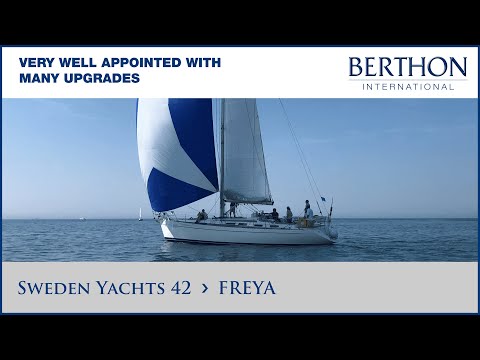
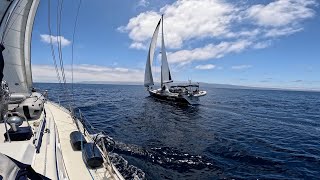
The Sweden Yachts 42 is a fractional sloop designed for performance cruising, with a fin bulb keel and spade rudder. Aboard *Halcyon Yachts - International Yacht Delivery*, a Sweden Yachts 42 named *Spindrift* completed a 4,330-nautical-mile Atlantic crossing as part of the ARC Europe 2025 rally, maintaining an average speed of 10 knots in heavy air and reaching 9.5 knots with an asymmetric spinnaker.8:51 The vessel navigated varied conditions, including 35-knot winds, electrical storms, and periods of calm that required three days of motoring. *Berthon International* toured *Rhapsody*, a 2003 model, noting its semi-fractional rig with a self-tacking track, 110% overlapping jib, and North Turlam sails.2:03 Its cockpit features a bow thruster, autopilot, plotter, and Anderson stainless winches, with electric aft winches and all control lines led aft.3:18 The interior of *Rhapsody* is finished in satin and gloss varnished mahogany with teak and holly soles, offering an offset double berth forward and two aft cabins. *Freja*, a 2004 model toured by *Berthon International*, underwent a 2017 refit of electronics and rigging, and received a new Selden mast and Sanders mainsail in 2023 for short-handed sailing with in-mast furling. *Freja* also features a self-tacking headsail, powered control line winches, a large forward sail locker, and a sugar-scoop stern.2:20 Both *Rhapsody* and *Freja* are powered by Volvo D255 engines with additional alternators for domestic battery banks.7:04
Fuentes
- SWEDEN YACHTS 42 - sailboatdata
- Sweden Yachts 42
- Sweden 42 Sailboat Review, Specs, and Listings
- SWEDEN YACHTS 42 Sail Dimensions, Specs & Sail Pricing
- Sweden Yachts 42
- The Sweden Yachts 42 Sailboat
- Sweden Yachts 42 - Båtagent
- Sweden Yachts 42 - Segelbåtar - Båtguiden - Maringuiden
- Sweden Yachts 42, 2003 - Båtagent
- Sweden Yachts 42 - Specifikationer, fakta & tester
- Sweden Yachts 42 - Yachting World
- Sweden Yachts 42
- [PDF] Sweden Yachts 42 – 2003 - Båtagent
- SWEDEN YACHTS 42 - Fakta, bilder, prisstatistik, ...
- Sweden Yachts 42 - Segelbåtar - Båtguiden - Maringuiden