Yourbestsailvideo
Anchoring: wave diffraction
16 de junio de 2026 · 12 min · 2K vistas
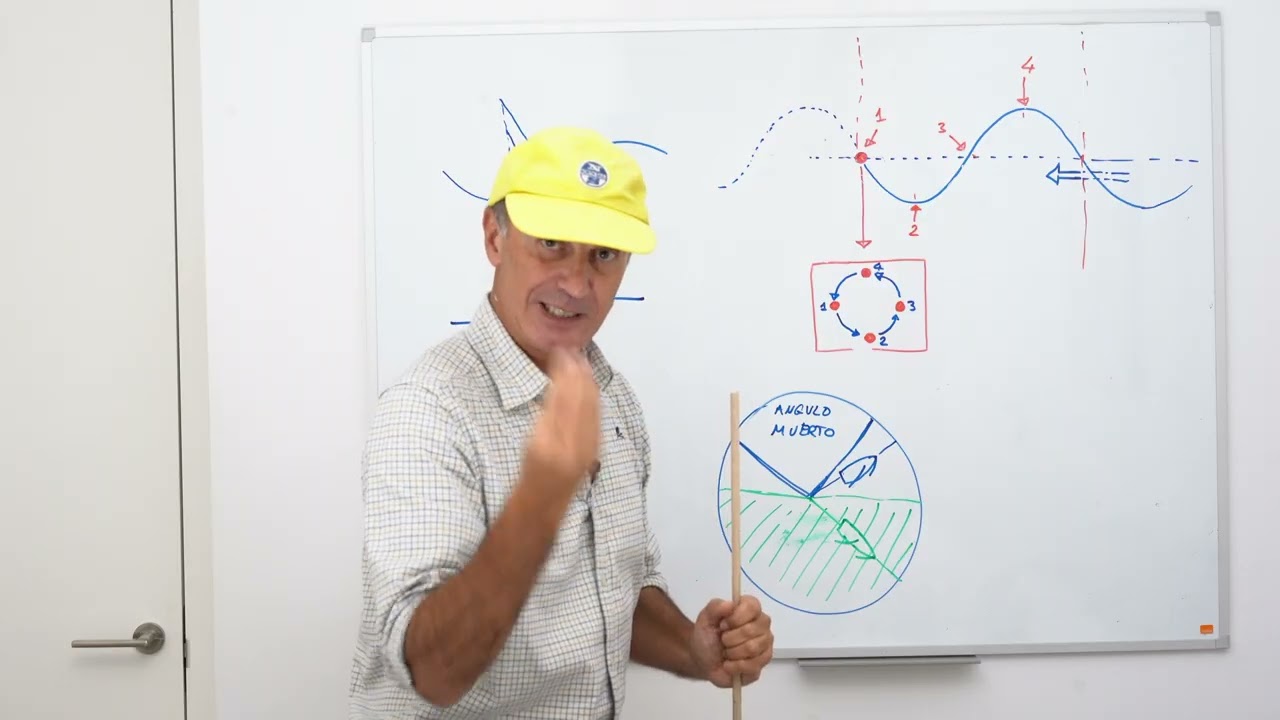
Man draws wave motion on whiteboard for sailing lesson
¿Qué cubre este video?
Wave diffraction causes swell to bend around headlands and into apparently sheltered anchorages — a phenomenon the video explains through diagrams and a personal experience. When a swell's wavelength (crest-to-crest distance) is comparable to or larger than the width of a bay entrance or the gap beside a promontory, the waves curve around the obstacle and penetrate the anchorage even when wind direction and fetch are favorable.7:43 When the wavelength is much smaller than that characteristic distance, waves travel in a straight line and the bay stays calm.10:44 The tutorial first reviews two core anchorage-selection criteria: anchoring in the lee of the coast to eliminate fetch and avoid a lee shore if dragging occurs, and separately checking swell direction — using apps such as Windy or Navili — because swell can arrive from a completely different direction than the current wind.3:28 Sandy bottoms are recommended for plow-type anchors (CQR, Delta, Rocna).5:20 Diffraction applies equally to a narrow-mouthed bay: if the entrance width is similar to the incoming wavelength, swell fans out across the entire interior.10:19
Más de Yourbestsail

De Yourbestsail — ve el barco, la tripulación y cada video analizado del canal.
The Sailing Directory Newsletter
Un correo electrónico con los mejores hallazgos de la flota: los momentos, barcos e historias que valen tu tiempo de visualización. Ingresa tu propia dirección para obtener tu propia copia.