Yourbestsailvidéo
Anchoring: wave diffraction
16 juin 2026 · 12 min · 2K vues
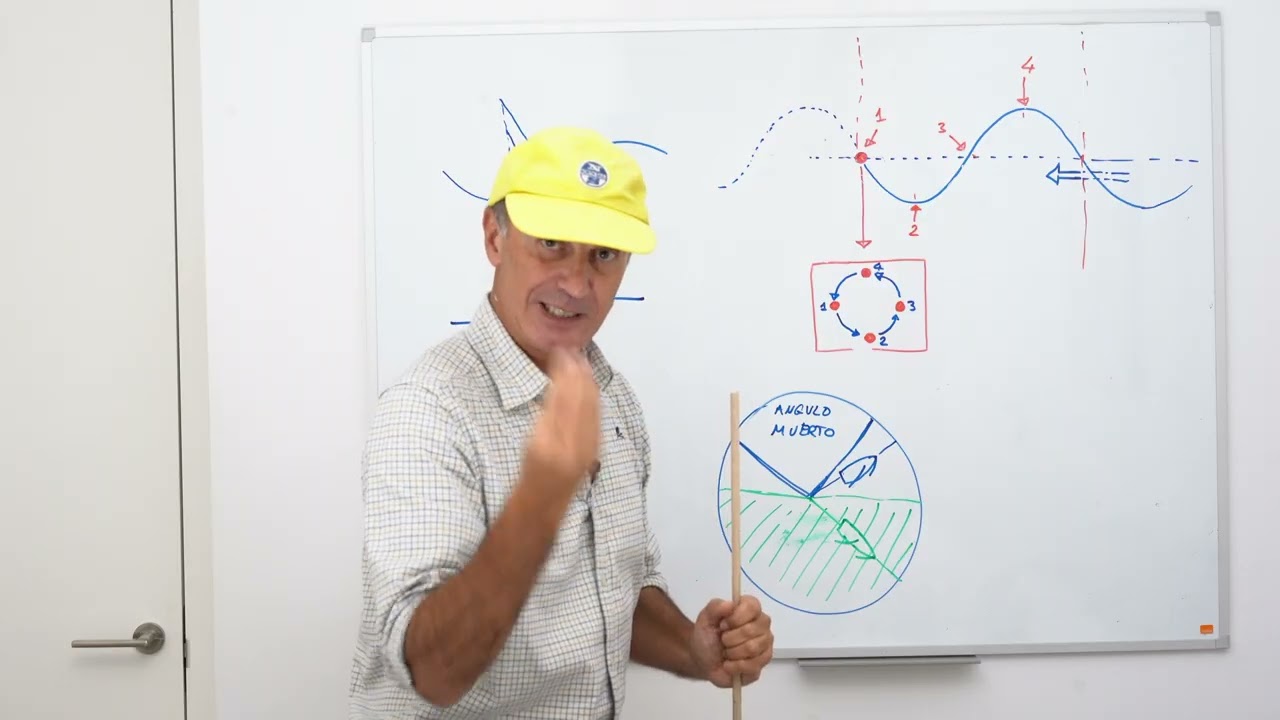
Man draws wave motion on whiteboard for sailing lesson
Ce que couvre cette vidéo
Wave diffraction causes swell to bend around headlands and into apparently sheltered anchorages — a phenomenon the video explains through diagrams and a personal experience. When a swell's wavelength (crest-to-crest distance) is comparable to or larger than the width of a bay entrance or the gap beside a promontory, the waves curve around the obstacle and penetrate the anchorage even when wind direction and fetch are favorable.7:43 When the wavelength is much smaller than that characteristic distance, waves travel in a straight line and the bay stays calm.10:44 The tutorial first reviews two core anchorage-selection criteria: anchoring in the lee of the coast to eliminate fetch and avoid a lee shore if dragging occurs, and separately checking swell direction — using apps such as Windy or Navili — because swell can arrive from a completely different direction than the current wind.3:28 Sandy bottoms are recommended for plow-type anchors (CQR, Delta, Rocna).5:20 Diffraction applies equally to a narrow-mouthed bay: if the entrance width is similar to the incoming wavelength, swell fans out across the entire interior.10:19
Plus de vidéos de Yourbestsail

De Yourbestsail — voir le bateau, l'équipage et chaque vidéo analysée de la chaîne.
The Sailing Directory Newsletter
Un e-mail avec les meilleures trouvailles de la flotte — les moments, les bateaux et les histoires qui valent la peine d'être regardés. Entrez votre adresse pour recevoir votre propre exemplaire.