How to Choose 12V vs 24V vs 48V (in an Off Grid Electrical System) - Battery Basics | Ep 5/7
19 de setembro de 2025 · 22 min · 50K visualizações
Man points to battery setups on studio table
O que este vídeo aborda
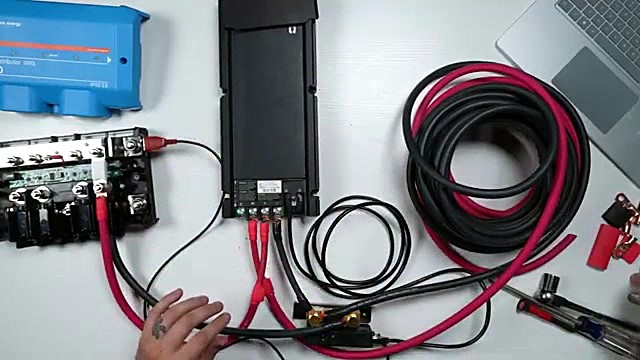
Selecting a battery bank system voltage—12V, 24V, or 48V—depends primarily on total inverter wattage requirements and the resulting amperage draw.3:14 Higher system voltages allow for lower amperage, which enables the use of smaller, more manageable wire sizes like 1-aught instead of 4-aught.7:08 For a 3,000-watt inverter, 12V is standard, but 5,000-watt systems perform better at 24V, and 10,000-watt systems require 48V to keep amperage within safe, practical limits.3:32 Solar capacity also dictates voltage choice; a 48V system allows for up to 5,800 watts of solar on a single 100-amp charge controller, whereas a 12V system is limited to 1,450 watts for the same controller.10:01 Mobile applications with 30-amp or 50-amp shore power require specific inverter-charger configurations, such as Victron 2x120 units for split-phase 50-amp service.16:23 Stationary off-grid applications, such as cabins, favor 48V systems to simplify integration with standard residential breaker boxes and minimize wiring complexity.19:12
Mais de EXPLORIST life Mobile Marine & Off-Grid Electrical




De EXPLORIST life Mobile Marine & Off-Grid Electrical — veja o barco, a tripulação e cada vídeo analisado do canal.
The Sailing Directory Newsletter
Um e-mail com os melhores achados da frota — os momentos, barcos e histórias que valem o seu tempo de visualização. Insira seu endereço para receber sua própria cópia.