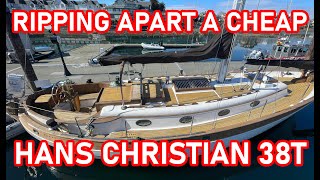
Investigado a través de fuentes publicadas
La historia del North Star 80/20
Cómo surgió este modelo, quién lo diseñó, qué cambió durante su producción y qué se ha escrito sobre él desde entonces. Cada afirmación incluye su fuente; ▶ marca el inicio de metraje real de un barco de este modelo.
The North Star 80/20: History, Design, and Legacy of a Canadian Blue‑Water Ketch
The North Star 80/20 occupies a distinctive niche in the history of production cruising yachts: a heavily built, center‑cockpit masthead ketch conceived by Sparkman & Stephens in the early 1970s and constructed in limited numbers by Canadian boatyards under the North Star and Hughes names. Published records agree that the design, catalogued by Sparkman & Stephens as design number 2134, was first launched around 1973 and soon evolved into the closely related Hughes 40 and Hughes Columbia 40 while retaining the same essential hull, rig, and interior concept. With an overall length of about 40 feet, a beam in the 13‑foot range, displacement in the mid‑twenty‑to‑high‑twenty‑thousand‑pound bracket, and a moderate draft under 5 feet, the 80/20 placed seakindliness and interior volume ahead of outright speed, pairing a longish fin keel and skeg‑hung rudder with a two‑mast ketch rig that allowed conservative, easily handled sail plans on ocean passages. Contemporary and retrospective descriptions consistently emphasize the boat’s unusually robust fiberglass construction, substantial ballast ratio, and center‑cockpit layout with a separate aft cabin and dual heads, elements that helped cement its reputation as a “tank‑like” blue‑water cruiser in owner communities and brokerage literature. Though only on the market for a brief period and built in relatively small numbers—about two dozen hulls according to one widely cited compilation—the design has continued to attract offshore‑oriented buyers, and surviving examples now form a scattered global fleet found in North America, Europe, and Mexico, often advertised with stories of long voyages and refits aimed at trans‑oceanic cruising.
Origins in the 1970s Fiberglass Cruising Boom
Sparkman & Stephens and Design 2134
The North Star 80/20 traces its origin to the renowned naval architecture firm Sparkman & Stephens, whose design office in New York was a dominant force in both racing and cruising yacht design through much of the twentieth century. The boat is identified in multiple summary records as a production version of Sparkman & Stephens design number 2134, a cruiser conceived with a masthead ketch rig, center cockpit, and moderate fin‑and‑skeg underwater profile. A general description of the design in a widely consulted encyclopedic source notes that the North Star 80/20 was explicitly drawn as a cruiser rather than a racing hull, situating it within Sparkman & Stephens’ portfolio of comfortable, ocean‑capable family boats rather than their more extreme performance designs. The same source states that the boat was first built in 1973, marking it as an early‑to‑mid 1970s product of the transition period in which many yards shifted from wood and steel construction to fiberglass as the primary material for larger ocean‑going yachts.
Critical numerical characteristics associated with design 2134 recur consistently across design records and later marketing material: an overall length of 40 feet, a waterline length of 31 feet, a beam in the range of 13.25 to 13.33 feet, and a masthead ketch rig with a reported total sail area in the vicinity of (786\ \text{ft}^2). These numbers appear both in the records for the North Star 80/20 and in those for the closely related Hughes 40 and Hughes Columbia 40, reinforcing the view that all three labels refer to successive production phases of essentially the same Sparkman & Stephens design. The continuity of hull dimensions and sailplan geometry across these names—despite minor discrepancies that will be examined later—supports the conclusion that the original design 2134 provided the enduring template for a family of Canadian‑built center‑cockpit ketches marketed to offshore cruisers.
Canadian Builders: North Star Yachts and Hughes Boat Works
The corporate and branding context for the North Star 80/20 is somewhat complex, because surviving documentation refers to both North Star Yachts Ltd. and Hughes Boat Works as builders of the design. A modern data compilation describing the boat’s history explicitly lists the builder as North Star Yachts Ltd., a Canadian company, and notes that the model was constructed from 1973 to 1976. In contrast, a detailed brokerage listing for a 1975 example presented in Europe identifies the builders as Hughes Boat Works, while simultaneously describing the model name as “NorthStar 80/20 Sparkman & Stephens,” thus pairing the North Star trade name with the Hughes yard in a single phrase. Another brokerage site offering a 1976 vessel in Florida explains that “The Hughs 40 also known as a North Star 80/20” was designed by Sparkman & Stephens and built in Ontario, Canada, again linking the Hughes and North Star identities with the same hull and design.
Taken together, these descriptions indicate that the industrial reality behind the North Star 80/20 involved one or more Canadian facilities associated with the Hughes name producing boats that were marketed at least initially under a North Star brand. The fact that some later records, particularly those emphasizing the Hughes 40 variant, refer to “Hughes Columbia 40” suggests that the boatyard’s corporate and branding arrangements evolved over time, reflecting wider patterns in the Canadian boatbuilding industry during the 1970s and early 1980s in which builders sometimes partnered with larger American brands or rebranded lines to reach different markets. While the exact corporate structure is not fully spelled out in the surviving design summaries and brokerage narratives, the dual attribution across multiple records makes clear that the North Star 80/20 should be understood as part of the Hughes family of boats, even when sold or catalogued under the North Star label.
Position in the 1970s Cruising Market
Contemporary and retrospective characterizations show that the North Star 80/20 was positioned squarely in the blue‑water cruising segment rather than in coastal or racing markets. A detailed descriptive review in a modern specifications and commentary resource characterizes the boat as “a straightforward, well‑proportioned cruiser‑ketch from the early 1970s, built in fiberglass with a practical three‑cabin interior and enough tankage for extended stays.” Another summary aimed at owners and prospective buyers emphasizes its “heavy‑displacement fiberglass cruising ketch” nature, highlighting the design’s solid construction, exceptional stability in heavy weather, and center‑cockpit layout intended to maximize safety and privacy on long passages. Brokerage listings commonly describe individual boats as “true blue‑water” vessels, as in a Florida advertisement that notes the Hughes 40/North Star 80/20 is considered a genuine offshore platform, and as in a Mexican listing where a refitted example is introduced as an “incredible blue‑water yacht” with a “true cruising hull.”
These characterizations align with the numerical and structural attributes of the design, which combine heavy displacement, moderate draft, substantial ballast, and a conservative sailplan in a package that emphasizes comfort over speed. At a waterline length of 31 feet, the theoretical hull speed for the North Star 80/20, calculated using the standard formula (V = 1.34 \sqrt{\text{LWL}}), is approximately (1.34 \times \sqrt{31} \approx 7.46) knots, a figure that appears explicitly in one modern review and reflects the boat’s intended performance envelope. This modest hull speed, paired with a ballast ratio around the mid‑thirty‑percent range as calculated in published records, underlines the design’s focus on steady, predictable behavior rather than dramatic racing speeds.
Hull Form, Rig, and Construction
Underwater Profile: Fin Keel, Long Keel, and Skeg‑Hung Rudder
One of the more intriguing technical aspects of the North Star 80/20 is the variety of language used in different sources to describe its keel configuration, even though all agree that the boat carries a skeg‑mounted rudder. A widely consulted encyclopedic summary describes the 80/20 as having “a fixed fin keel” and a skeg‑mounted rudder controlled by a wheel, explicitly using the term “fin keel” to categorize its underwater shape. A modern review and specification resource aimed at buyers likewise refers to the yacht as a solid‑fiberglass monohull with a fixed fin keel drawing 4.75 feet and a skeg‑mounted rudder steered by a wheel, thus reinforcing the fin‑and‑skeg characterization. A design database entry for the later Hughes 40 variant, which notes that an earlier version was called the North Star 80/20, also lists the hull type as “Fin with rudder on skeg,” further supporting the classification of design 2134 as a fin‑keel boat, albeit with a protective skeg.
However, several brokerage descriptions introduce different terminology that has contributed to some ambiguity in how owners and observers talk about the keel. The detailed Mexican listing for the refitted boat “Luna Azul” describes the yacht as having a “true cruising hull – modified (long) fin keel and skeg hung rudder,” suggesting that while the keel is technically a fin, its fore‑and‑aft length is greater than that of a typical high‑aspect racing fin, enough that the broker chooses to emphasize its length in narrative terms. A European advertisement for a 1975 NorthStar 80/20 Sparkman & Stephens ketch succinctly lists the keel type simply as “Long keel,” compressing the nuance into the more traditional label used by many cruising sailors for keels that extend significantly along the hull’s bottom profile. Yet another brokerage listing for a 1976 example in Florida again refers to the vessel as staying upright in heavy air with her “modified long fin keel and skeg hung rudder,” combining both fin and long qualifiers in the same phrase.
Taken together, these descriptions point to a keel design that lies on the spectrum between classic full keels and modern short racing fins, prompting different writers to select terminology that reflects their perspective. From a technical standpoint, the continuity of fin‑and‑skeg language in design records and specifications databases, along with draft figures that are moderate rather than deep, suggests that Sparkman & Stephens intended a compromise form: a relatively long chord fin keel offering good directional stability and structural support, paired with a skeg‑mounted rudder to protect steering gear and enhance tracking at sea. Brokerage language highlighting the “long” nature of the fin and referring to the keel as long in casual shorthand underscores the boat’s conservative, cruising‑oriented underwater profile, in contrast to the short high‑aspect fins common on lighter performance hulls.
Principal Dimensions, Displacement, and Ballast
Despite the overall consistency of the design, published numerical specifications for the North Star 80/20 and its closely related variants exhibit minor but noteworthy discrepancies in displacement, ballast, beam, and draft figures, reflecting differences in measurement practices, design evolution, and possibly marketing choices. A widely cited encyclopedic entry and a dedicated design summary both give the North Star 80/20 an overall length of 40.00 feet, a waterline length of 31.00 feet, a beam of 13.33 feet, a draft of 4.75 feet, a displacement of 24,600 pounds, and ballast of 9,000 pounds. Using these numbers, the ballast ratio is about (9{,}000 / 24{,}600 \approx 36.6%), a figure explicitly calculated and discussed in one modern review as contributing to the boat’s steady, grounded feel.
By contrast, a design record for the Hughes 40, which identifies the North Star 80/20 as its earlier version, lists a displacement of 28,000 pounds and ballast of 9,200 pounds, with a beam of 13.25 feet and a maximum draft of 4.67 feet. A specification sheet for the Hughes Columbia 40, another evolution of the same center‑cockpit ketch, repeats the displacement of 28,000 pounds, gives ballast as 9,000 pounds, and lists beam at 13.4 feet and draft at 4.9 feet. These values, while close, imply either minor design changes or differing assumptions about load condition and configuration; for instance, the roughly 3,400‑pound increase in displacement from 24,600 pounds to 28,000 pounds between sources may represent the addition of gear, tanks, and structural reinforcements in later iterations rather than a fundamental hull redesign.
A brokerage listing for a 1973 boat in Mexico, which closely mirrors the encyclopedic specifications, confirms the 40‑foot overall length, 31‑foot waterline, 13.33‑foot beam, and 4.75‑foot draft for the North Star 80/20, reinforcing the notion that these dimensions reflect the original configuration. Another brokerage record for a 1976 Hughes 40/North Star 80/20 in Florida lists a beam of 13 feet 4 inches and a draft of 5 feet, slightly different from the 4.75‑foot figure but within the range indicated by the Hughes Columbia specifications, suggesting either a small measurement discrepancy or a modest keel or loading difference. A sales brochure for a 1978 Hughes 40 ketch likewise lists a maximum draft of 4 feet 6 inches, with the same 13 feet 4 inches beam and 28,000‑pound dry weight, showing that, in practice, the design floated at slightly varying drafts depending on ballast load, keel variant, and survey methodology.
These overlapping yet non‑identical numbers reflect the complexity of describing a design that evolved over several model names and years, and they highlight the importance of treating published specifications as indicative rather than mathematically exact. For owners and prospective buyers, the key takeaway is that the North Star 80/20 family comprises 40‑foot center‑cockpit ketches with beams around 13.25–13.4 feet, drafts between about 4.6 and 5.0 feet, displacements in the mid‑to‑upper 20,000‑pound range, and ballast near 9,000 pounds, a combination that yields a moderate ballast ratio and substantial mass for offshore voyaging.
Comparative Specifications Table
The variations across major published sources can be visualized by placing representative figures side by side. The following table summarizes key hull and weight data for the North Star 80/20, Hughes 40, and Hughes Columbia 40 as reported in three distinct records.
| Model / Source | LOA (ft) | LWL (ft) | Beam (ft) | Draft (ft) | Displacement (lb) | Ballast (lb) |
|---|---|---|---|---|---|---|
| North Star 80/20 (design summary) | 40.0 | 31.0 | 13.33 | 4.75 | 24,600 | 9,000 |
| Hughes 40 (design database) | 40.0 | 31.0 | 13.25 | 4.67 | 28,000 | 9,200 |
| Hughes Columbia 40 (spec sheet) | 40.0 | 31.0 | 13.4 | 4.9 | 28,000 | 9,000 |
The table underscores how all three records cluster tightly around the same basic dimensions while diverging modestly in beam, draft, displacement, and ballast, a pattern consistent with incremental design development and differences in reporting conventions rather than with major structural changes.
Rig Geometry and Sailplan
The North Star 80/20 is consistently described as carrying a masthead ketch rig of the Bermuda type, with two masts and a split sailplan intended for ease of handling on long passages. A modern review detailing the rig notes that the boat’s mainsail is just over 300 square feet and the working jib or genoa area near 345 square feet, for a total of roughly 648 square feet of canvas across main and headsail in typical working configuration. That same review explains that the foretriangle measures 49.25 feet in the “I” dimension and 14 feet along the “J” base, while the main luffs 43.25 feet, figures that correspond closely to those in a design specification table listing I = 49.30 feet, J = 14 feet, P (main luff) = 43.30 feet, and E (main foot) = 14 feet. In addition, the mizzen mast carries a luff P2 of 28.25 feet and foot E2 of 9.75 feet according to the same design compilation, underscoring the substantial size of the aft sail.
A specification sheet for the Hughes Columbia 40 corroborates these magnitudes, giving a mainsail area of 303 square feet, a 100 percent foretriangle area of 345 square feet, and a mizzen of 138 square feet, for a total sail area of 786 square feet. A design database entry for the Hughes 40 similarly reports sail area of 786 square feet, reinforcing that this is the standard nominal sailplan for the design 2134 family. Taken together, these figures show that while the working total area cited in one review excludes the mizzen and emphasizes day‑to‑day main and headsail use, the full rig’s potential area is significantly greater when the mizzen is set, yielding a robust sailplan appropriate to a heavy displacement hull.
Listings for individual boats corroborate that these general design figures translate into practical rigs in service. A European broker’s description of a 1975 NorthStar 80/20 Sparkman & Stephens, for example, lists a classic battened mainsail with lazy bag and jacks, a classic battened mizzen also with lazy bag and jacks, a roller‑reefing genoa, and a spinnaker, with the spinnaker boom and associated equipment included. Another listing describes the boat simply as a masthead ketch with center cockpit, highlighting the staple configuration rather than its numerical details. These accounts illustrate how the design’s rig, while numerically defined in formal specifications, is manifest in practice as a versatile setup allowing a range of sail combinations tailored to conditions, from main and genoa alone in lighter winds to reduced sail with mizzen for balance in heavier weather.
Materials and Structural Strength
One of the defining characteristics of the North Star 80/20 in owner lore and modern commentary is its unusually robust fiberglass construction, which has contributed significantly to its reputation as a durable blue‑water cruiser. A widely cited design summary aimed at experienced sailors notes that the boat was built with solid fiberglass rather than core materials, and specifies hull thickness on the order of 1 3/8 inches and deck thickness of roughly half an inch, describing this as “tank‑like” construction in contrast to lighter contemporary production boats. This same account emphasizes that the hull and decks are entirely solid, not balsa cored, and presents this as a key factor in the boat’s ability to withstand heavy seas and the occasional impact with floating debris or harbor structures.
An encyclopedic entry supports this picture by stating that the North Star 80/20 is a recreational keelboat built predominantly of fiberglass with wood trim, underscoring the material choice even if not detailing thickness. A modern review further describes the boat as a solid‑fiberglass monohull with wood trim, reiterating that the hull is not built with composite sandwich techniques and highlighting its weight and stiffness. Multiple brokerage listings for boats built in the mid‑1970s report that the hull material is fiberglass and that the boats have survived decades of service, often undergoing major refits to update systems while retaining their original structural shell.
These accounts collectively show that the design 2134 family, including the North Star 80/20, Hughes 40, and Hughes Columbia 40, belongs to a generation of robustly built cruising yachts constructed during a period when fiberglass technology was still relatively new and builders tended to err on the side of material thickness and mass. The weight and solidity that result from this approach contribute to the boat’s heavy displacement and moderate performance, but they also underpin its blue‑water credentials by providing a margin of safety that many owners and brokers continue to emphasize in sales narratives and community discussions.
Deck, Cockpit, and Interior Layout
The North Star 80/20’s topside and interior layout center around a raised center cockpit, aft cabin, and walk‑through passage that together create an arrangement particularly well suited to long‑distance cruising with multiple people aboard. A modern review describes the boat’s interior as sleeping seven across a bow cabin with a double V‑berth, a main saloon with three straight settee berths, and an aft cabin carrying another double V‑berth, painting a picture of a three‑cabin layout with separate sleeping areas fore and aft. A detailed design summary similarly notes a center cockpit layout that maximizes privacy by separating the forward and aft sleeping spaces, and highlights the presence of two heads, one associated with the aft cabin and one forward, as a key feature for comfortable extended stays.
Brokerage listings for individual boats corroborate this general plan while adding concrete details. The Mexican listing for “Luna Azul” explains that the Northstar 80/20 (later known as the Hughes 40) is a beamy aft cabin center cockpit cruising yacht equipped with two staterooms and two heads, a very large main salon, galley, navigation station, and a walk‑through to the aft cabin. A European advertisement similarly notes that the boat has two cabins, two bathrooms, and six berths, with two toilets and two showers, confirming the dual‑head configuration and the division into forward and aft cabins. A Florida brokerage listing reports that the boat has two cabins, sleeps six, and includes two heads, while a detailed Hughes Columbia 40 specification sheet indicates that the design can berth eight, suggesting that the practical number of berths may vary somewhat depending on interior configuration, but always within a range that supports multi‑person crews.
Tankage figures in these records further highlight the boat’s orientation toward cruising. The Hughes Columbia 40 spec sheet lists fuel capacity of 75 U.S. gallons and water capacity of 180 U.S. gallons, volumes suitable for extended time at sea or in remote anchorages. The Mexican listing for a Northstar 80/20 reports a fuel tank of 60 gallons and fresh water tankage of 80 gallons, while the Florida brokerage listing indicates 50 gallons of fuel and 80 gallons of fresh water, differences that likely reflect either tank replacement over the life of individual boats or differing interpretations of usable capacity. A European advertisement lists fresh water capacity at 300 liters, equivalent to around 79 U.S. gallons, again aligning with the 80‑gallon range for water on some examples.
These converging descriptions reveal that while specific numbers may vary, the North Star 80/20 was designed around a structurally robust, center‑cockpit arrangement with two separated sleeping cabins, dual heads, a spacious saloon, and significant fuel and water tankage, all of which mark it as an offshore‑capable cruiser rather than a weekend boat.
Engine Installations and Repowering
Engine installations on the North Star 80/20 and its Hughes descendants illustrate both the design’s original specification and the evolution of individual boats through repowering over several decades. A widely consulted design summary indicates that the standard power plant was a Westerbeke 4‑154 diesel rated at 52 horsepower, and notes that many boats have been repowered to modern equivalents, reflecting both the age of the original engines and owner preferences for greater reliability and sometimes additional power. Brokerage listings and detailed sales brochures confirm that a variety of diesel engines now populate these hulls, often in the 70–80 horsepower range.
The Mexican listing for “Luna Azul” reports a Yanmar 4JH3‑TE turbocharged diesel with total power of 75 horsepower, a modern engine widely used in cruising boats of similar size. A detailed specification sheet in the same market listing for the boat identifies the engine model and total power as Yanmar 4JH3‑TE Turbo with 75 hp, emphasizing the repower as part of a comprehensive refit completed in 2019. A European listing for a 1975 NorthStar 80/20 Sparkman & Stephens notes that the boat is powered by a Ford Lehman engine rated at 74 hp, with the engine’s build year given as 1978, indicating either a repower at that time or a later installation into an existing hull. A Greek advertisement for a 1976 Northstar 80/20 ketch also cites a Ford Lehman diesel rated at 80 hp, showing that higher‑output Lehman engines are common in these boats, particularly in Europe.
Brokerage material for a 1976 Hughes 40/North Star 80/20 in Florida describes the propulsion simply as diesel, while a more detailed Hughes Columbia 40 spec sheet states “Power: 4 Cyl. Diesel” and lists fuel capacity at 75 gallons, suggesting an engine of similar type and range to the Lehman and Westerbeke units found in other examples. A sales brochure for a 1978 Hughes 40 ketch in New Jersey confirms the pattern by reporting a single Lehman inboard diesel rated at 80 hp, a fuel capacity of 75 gallons, and a dry weight (displacement) of 28,000 pounds.
This collection of records paints a clear picture: while the North Star 80/20 originated with a roughly 52‑hp Westerbeke diesel, most surviving boats now carry engines in the 70–80 hp range from manufacturers such as Yanmar and Ford Lehman, providing power reserves valuable for motoring against headwinds or currents in a heavy displacement cruiser. The prevalence of such repowers underscores both the design’s longevity and the willingness of owners to invest heavily in machinery upgrades to keep these boats viable as offshore platforms decades after their initial launch.
Production History and Model Evolution
Years of Production and Numbers Built
Although exact production numbers are difficult to verify decades after the fact, a widely consulted design summary provides the most specific estimate, stating that the North Star 80/20 was built in Canada from 1973 to 1976 and that only about 25 units were produced. This figure appears in a context that sets the design apart as rare and coveted among heavy‑displacement cruising ketches, suggesting that the small production run has contributed to its mystique in owner communities. The same summary emphasizes that the builder was North Star Yachts Ltd., reinforcing the view that the earliest boats carried the North Star brand rather than the Hughes name.
Year‑of‑build data from brokerage listings supports the 1973–1976 window for the North Star 80/20 and its Hughes 40 twin. A Mexican listing presents a Northstar 80/20 built in 1973, confirmed by the specification table, while Italian and European adverts offer 1975 examples clearly identified as NorthStar 80/20 Sparkman & Stephens. A Greek listing shows a Northstar 80/20 built in 1976, and a Florida brokerage listing for a 40‑foot Hughes 40/North Star 80/20 also dates the hull to 1976. A design database entry for the Hughes 40 notes that the model was first built in 1975, consistent with the idea that Hughes‑branded production overlapped with or followed the initial North Star run.
In addition, a Hughes Columbia 40 specification sheet featuring a 1981 diagram indicates that by the early 1980s the same core design was being marketed under the Hughes Columbia 40 name, implying that production or at least marketing continued under a new label beyond the 1976 date cited for the North Star brand. A 1978 Hughes 40 ketch described in a detailed sales brochure further confirms that boats of this design were still being built or at least launched in the late 1970s, reinforcing the notion of a continuous production lineage under changing brand names.
Taken together, this evidence suggests that while the North Star 80/20 name itself may have been used primarily between 1973 and 1976, the underlying Sparkman & Stephens design 2134 was produced in closely related variants through at least the late 1970s and possibly into the early 1980s under Hughes and Hughes Columbia branding. The figure of “about 25” units for the North Star 80/20 therefore likely refers specifically to hulls bearing that initial brand, rather than to the total output of the design across all subsequent labels.
Transition to Hughes 40 and Hughes Columbia 40
A key piece of evidence for the model evolution from North Star 80/20 to Hughes 40 comes from a design database entry that explicitly states: “An earlier version was called the NORTH STAR 80/20.” This entry, presented under the heading Hughes 40, lists all the familiar dimensions—LOA 40 ft, LWL 31 ft, beam 13.25 ft, fin with rudder on skeg hull type, masthead ketch rig, and sail area of 786 square feet—and thus confirms that the Hughes 40 is effectively the same design as the North Star 80/20 in its matured form. The displacement and ballast figures in this entry, 28,000 and 9,200 pounds respectively, represent one of the main numerical differences from earlier North Star specifications, but they do not imply any radical change in hull shape or concept.
The Hughes Columbia 40 specification sheet provides further context, introducing the model explicitly as a center‑cockpit ketch with LOA 40 ft, LWL 31 ft, beam 13 ft 4 in, draft 4 ft 9 in, displacement 28,000 lb, ballast 9,000 lb, and sail area 786 square feet. This document, which includes a 1981 diagram of the boat, indicates that the 40‑foot center‑cockpit ketch design continued under the Hughes Columbia brand at least into the early 1980s, maintaining the key attributes associated with the original North Star 80/20. The fact that the Columbia name appears in conjunction with Hughes on this sheet suggests a marketing or corporate alignment, possibly reflecting licensing or collaboration with the Columbia Yachts brand, although the sheet itself focuses primarily on technical specifications rather than corporate details.
Brokerage listings further reinforce the intertwined naming of the design. The Florida brokerage listing for a 1976 boat routinely refers to the vessel as both “Hughs 40” and “North Star 80/20,” spelling Hughes with a minor variation but clearly treating the names as interchangeable. The Mexican listing for “Luna Azul” describes the boat as a Northstar 80/20 and parenthetically notes that it later became known as the Hughes 40, directly linking the two labels for readers. These practical sales descriptions, grounded in the lived experience of owners and brokers handling the actual boats, corroborate the formal design database assertion that the North Star 80/20 and Hughes 40 are variants of the same Sparkman & Stephens design.
Geographic Distribution of Surviving Boats
The modern brokerage market for North Star 80/20 and Hughes 40 boats offers insight into the geographic distribution of surviving hulls and the cruising patterns associated with the design. Listings sampled in recent years show examples located in Florida, Mexico, Greece, Italy, and New Jersey, among other places, providing a snapshot of a fleet now scattered across multiple continents. The Mexican listing for “Luna Azul” situates the boat in La Paz, on the Sea of Cortez, an area known as a hub for Pacific cruising and staging for longer voyages to the South Pacific, and notes that the vessel was being prepared to cross the Pacific. The Florida brokerage listing places a Hughes 40/North Star 80/20 in Port Charlotte, on the Gulf Coast of the United States, again a region frequented by cruisers who may head for the Caribbean or Central America.
European listings add to this picture. An Italian brokerage advertises a 1975 NorthStar 80/20 ketch, while a Greek listing offers a 1976 Northstar 80/20 located in Greece, indicating that several boats have either been sold to European owners or sailed across the Atlantic and settled there. A sales brochure for a 1978 Hughes 40 in New Jersey shows that at least one example has spent time in the northeastern United States, a common starting point for coastal and offshore cruising along the U.S. East Coast and to Bermuda. The presence of a design summary emphasizing the boat’s reputation among serious offshore sailors suggests that beyond these specific locations, other hulls have likely circulated through blue‑water routes, though detailed voyage logs fall outside the scope of the available records.
These scattered location data points, associated with boats built in the mid‑1970s and still in circulation decades later, highlight both the durability of the North Star 80/20 design and its adoption by owners engaged in serious cruising rather than sedentary marina life. They reinforce the impression that, although rare in absolute terms, the boats form a small but widely dispersed fleet whose members have often covered substantial distances under sail and power.
Sailing Characteristics and Owner Experience
Performance Profile and Hull Speed
The performance profile of the North Star 80/20 reflects its heavy displacement and cruising‑oriented hull shape, with most sources emphasizing comfort and predictability over speed and pointing ability. A modern review devoted to the model calculates the hull speed at 7.46 knots, a figure derived from the standard formula (V = 1.34 \sqrt{\text{LWL}}) using a waterline length of 31 feet. Substituting (LWL = 31) into the formula yields (V \approx 1.34 \times \sqrt{31} \approx 1.34 \times 5.567 \approx 7.46) knots, confirming the reviewer’s calculation and underscoring that the boat’s theoretical maximum displacement speed is modest by contemporary performance standards.
The same review characterizes the boat’s ballast ratio as roughly 36.6 percent, based on 9,000 pounds of ballast and 24,600 pounds of displacement, and interprets this figure as contributing to a steady, grounded feel rather than to nimble or highly responsive performance. This aligns with broader owner and broker commentary that portrays the North Star 80/20 as “staying upright in heavy air,” as one Florida brokerage listing puts it, while acknowledging that the design does not sail as close to the wind as more performance‑oriented hulls. A discussion thread among sailors familiar with the Hughes 40/North Star 80/20 notes that the boat is recognized as a robust Sparkman & Stephens design but that it tends not to point particularly high and may lack the most elegant or classic lines, capturing the trade‑off between sturdiness and aesthetics or windward performance in informal community terms.
A widely consulted design summary goes further in emphasizing the boat’s blue‑water behavior, describing it as known for exceptional stability in heavy weather and underlining the contribution of its heavy displacement, solid fiberglass construction, and ballast to its ability to ride through large seas. These comments are consistent with the fundamental physics of heavy cruising hulls, which, while slower to accelerate and less lively in light airs, tend to have comfortable motion and strong resistance to capsize at the cost of speed and agility, particularly upwind. The North Star 80/20’s modest hull speed and significant ballast thus fit squarely into the design philosophy of offshore comfort and safety.
Handling and the Masthead Ketch Rig
The masthead ketch rig of the North Star 80/20 contributes significantly to its handling characteristics and appeal among cruising sailors. By splitting the sailplan across two masts—main forward and mizzen aft—the design allows owners and crews to tailor sail combinations to conditions with more granularity than a comparable sloop, often reducing sail simply by dropping or reefing the main while keeping a balanced mizzen and headsail combination set for stability. The working sail areas described in design summaries and specifications, with a main around 303 square feet, a foretriangle of 345 square feet, and a mizzen of 138 square feet, create a flexible palette that can be tuned for balance and comfort in varying wind strengths.
Brokerage listings that detail the rig confirm its practical setup. The European advertisement for a 1975 NorthStar 80/20 reports a classic battened main and mizzen, both equipped with lazy bags and jacks, facilitating quick reefing and dousing, and notes a roller‑reefing genoa and a spinnaker with dedicated boom, illustrating the boat’s capacity for both downwind sailing under large sails and conservative reefed configurations. A modern review describes the rig as Bermuda type masthead ketch, providing the familiar triangular mainsail and headsail shapes on both masts, and emphasizes that the division of area makes for manageable sail handling, particularly for smaller crews on longer passages.
Owner and broker commentary suggests that the ketch rig, in tandem with the center cockpit layout, contributes to a perception of safety and dryness at the helm. The Florida brokerage listing, for instance, calls the boat “a safe dry cruising platform,” and notes that the center cockpit has a reputation as a safe, dry helm area, implying that the high cockpit coamings, protective dodger, and relative separation from spray combine with the ketch rig’s ability to keep sails forward to reduce water coming aboard. The same listing remarks that the boat is known to remain upright in heavy air, a behavior facilitated in part by the ability to reduce sail in controlled steps using the ketch configuration.
Taken together, these accounts depict a design whose rig and handling characteristics are deliberately conservative, prioritizing ease of management, balance, and crew comfort over raw speed or racing performance, in keeping with its intended role as a blue‑water cruiser for families and small groups.
Blue‑Water Credentials and Voyaging Narratives
The blue‑water credentials of the North Star 80/20 are attested not only by design summaries and generic statements but by the specific ways in which individual boats have been outfitted and marketed for long‑distance voyaging. The Mexican listing for “Luna Azul” provides a particularly vivid example: it notes that the boat underwent a major refit in 2019, including extensive upgrades such as a high‑quality double‑skin inflatable tender, two outboard engines, full Raymarine electronics, a new multifunction display, and numerous spares, and explains that these changes were undertaken as she was being prepared to cross the Pacific. The description explicitly introduces the vessel as an incredible blue‑water yacht with a true cruising hull, modified long fin keel and skeg‑hung rudder, and highlights her beamy aft cabin and center cockpit as features suited for southern cruising with a shallow draft of only 5 feet.
A Florida brokerage listing similarly frames the Hughes 40/North Star 80/20 as “considered a true blue‑water vessel” and emphasizes that it is “a safe dry cruising platform ready for her next owner and adventure,” language that reflects both the broker’s marketing aims and the design’s established reputation. The same listing underscores that the boat is known to stay upright in heavy air and repeats the description of a modified long fin keel and skeg‑hung rudder, reinforcing the idea that its underwater profile is optimized for seakindliness and directional stability.
A widely consulted design summary, written from the perspective of experienced sailors, further reinforces these credentials, describing the North Star 80/20 as known among owner communities for exceptional stability in heavy weather and for a center‑cockpit layout that enhances safety at sea by keeping the helm predictable and protected. It also notes that the boat’s substantial solid fiberglass hull and decks, combined with its high ballast ratio, contribute to its “tank‑like” reputation and their attractiveness to serious offshore sailors despite the rarity of the model.
Although detailed voyage logs are not readily available in the sampled records, the fact that boats like “Luna Azul” are explicitly prepared for ocean crossings and are outfitted with long‑range gear such as large tenders, multiple engines, and modern navigation electronics suggests that owners and buyers view the design as suitable for major passages and treat it accordingly. The geographic distribution of surviving boats in cruising hubs such as La Paz, Florida, Greece, and Italy further supports this view, implying that many have either crossed oceans or are poised to do so under current or future owners.
Owner and Community Reception
Owner and community reception of the North Star 80/20 and its Hughes 40 twin, as reflected in design summaries, modern reviews, and online discussions, balances appreciation for robustness and comfort with a candid acknowledgment of modest performance and aesthetics. A design summary aimed at “good old boat” enthusiasts describes the model as rare and coveted, emphasizing its heavy‑displacement cruising ketch nature, solid construction, exceptional stability, and center‑cockpit layout, and thereby situating it among a class of boats valued for offshore capability rather than modern styling. This same account underscores the boat’s reputation for “tank‑like” strength, noting hull and deck thicknesses and all‑solid fiberglass construction, which appeal to sailors concerned with structural integrity in serious weather.
A modern review intended for prospective buyers portrays the boat as a straightforward, well‑proportioned cruiser‑ketch with practical three‑cabin interior and adequate tankage for extended stays, and notes that the ballast ratio and overall design give it a steady, grounded feel, while also stating that it does not claim nimble performance. In doing so, the review captures a balanced view: the North Star 80/20 is neither a sprightly racer nor an under‑sized coastal weekender, but instead a solid, conservatively rigged cruising platform that trades speed and windward ability for comfort and capacity.
An online discussion thread among sailors familiar with the Hughes 40/North Star 80/20 echoes this balance in informal terms, observing that the boat is recognized as a robust Sparkman & Stephens design, but that it does not sail especially close to the wind and may not have the most elegant or classic lines, thus summarizing both its strengths and perceived weaknesses relative to other boats in the eyes of some sailors. Brokerage narratives, while naturally optimistic, reinforce the positive aspects highlighted in these community descriptions, repeatedly calling the boat a true blue‑water vessel, safe, dry, and ready for adventure.
Taken together, these multiple perspectives indicate that the North Star 80/20 is appreciated among a subset of sailors who prioritize strength, seakindliness, and interior comfort over high performance or styling flair, and that its modest production numbers and design pedigree contribute to a certain niche appeal in the used‑boat market.
Technical Debates and Data Discrepancies
Keel Classification: Long versus Fin
As noted earlier, one of the recurring technical debates in the description of the North Star 80/20 involves whether it should be classified as a fin‑keel or long‑keel boat. Design records and formal specifications uniformly describe the hull type as a fin with rudder on skeg, indicating that the designer, Sparkman & Stephens, conceived the underwater profile as a fin keel rather than a full keel extending the length of the hull. Yet several brokerage listings, and in one case a succinct specification line, refer to the keel type as long keel, reflecting the subjective impressions of owners and brokers who experience the boat in service and evaluate its behavior and shape in relation to more extreme fin‑keel designs.
One plausible explanation for this discrepancy, consistent with the textual evidence, is that the North Star 80/20 uses a “modified long fin” keel—terminology that appears explicitly in brokerage descriptions for “Luna Azul” and the Florida Hughes 40/North Star 80/20—and that this compromise form leads some observers to classify it informally as long keel while others adhere to the technical fin classification. The presence of a substantial skeg supporting the rudder further visually connects the keel structure to the hull in a way reminiscent of traditional full keels, even though the actual ballast keel likely does not run the full length of the hull. In practice, this debate is more semantic than structural, as all sources agree on the presence of a skeg‑hung rudder and moderate draft, but it does illustrate how different descriptive traditions can coexist around a single design.
Displacement and Ballast Variations
Discrepancies in reported displacement and ballast figures, such as the 24,600‑pound displacement cited for the North Star 80/20 versus the 28,000‑pound displacement for the Hughes 40 and Hughes Columbia 40, raise questions about measurement and design evolution. One straightforward interpretation is that the lower displacement value represents the original design’s lightship or design weight, while the higher value reflects later models equipped with more substantial interior fittings, tankage, and gear or measured in full cruising trim. That would be consistent with the design summary’s portrayal of the North Star 80/20 as a heavily built boat to begin with, and with the tendency of owners to add equipment over time, thereby increasing real‑world displacement.
Alternative explanations include small design adjustments made during the transition from North Star 80/20 to Hughes 40, such as reinforcing structural elements, slightly altering keel profile, or modifying interior layout in ways that added weight without significantly changing principal dimensions. The fact that ballast figures also shift modestly—from 9,000 to 9,200 pounds in the Hughes 40 record, and back to 9,000 in the Hughes Columbia 40 spec sheet—suggests minor differences in ballast casting or reporting rather than fundamental changes in stability characteristics. In any case, the ballast ratio remains within a narrow band, around 32–38 percent depending on which displacement figure one uses, confirming the design’s underlying adherence to a moderately ballasted, heavy‑displacement philosophy.
Interior Capacity and Sleeping Arrangements
Reported sleeping capacities and cabin counts also exhibit minor variations across sources, reflecting both differing measurement or marketing conventions and the fact that interior configurations can be customized. The modern review that describes the North Star 80/20’s interior refers to seven berths: a double V‑berth in the bow cabin, three straight settee berths in the main saloon, and another double V‑berth in the aft cabin. The design summary aimed at experienced sailors lists berth capacity at eight, suggesting that some arrangements provide additional sleeping space, likely by converting settees or adding pilot berths.
Brokerage listings, by contrast, often present lower numbers that reflect practical sleeping capacity rather than theoretical maximums. The Mexican and Florida listings both state that their boats can sleep six and have two cabins and two heads, while a European listing notes six berths across two cabins and also reports two toilets and two showers. A sales brochure for a 1978 Hughes 40, however, lists sleeping capacity as four and number of berths as three, indicating either a conservative estimate or a customized interior with fewer permanent berths.
These differences highlight that the underlying design accommodates a range of interior configurations and that owners and brokers may describe capacity based on their particular arrangement and expectations—for instance, whether saloon settees are counted as regular berths, whether children’s bunks are considered, or whether maximum crowding is seen as realistic. The core pattern remains steady: two primary cabins fore and aft, a center saloon, and enough berths to house a family or crew of between four and eight depending on usage.
Engine Power and Tankage Differences
As with displacement and berths, reported engine power and tankage values vary across sources, reflecting both original design specifications and subsequent modifications. The design summary’s statement that the standard engine was a 52‑hp Westerbeke 4‑154 represents the original design intent, particularly for the North Star 80/20 brand phase. Later records showing Ford Lehman engines in the 74–80 hp range, Yanmar engines at 75 hp, and generic “4 Cyl. Diesel” descriptions with associated fuel capacity of 75 gallons illustrate that many boats have been repowered with more powerful engines over time.
Fuel and water tank capacities likewise differ among records. The Hughes Columbia 40 spec sheet lists 75 gallons of fuel and 180 gallons of water, while the Mexican listing for a Northstar 80/20 gives a 60‑gallon fuel tank and a 300‑liter (about 80‑gallon) fresh water tank. The Florida Hughes 40/North Star 80/20 listing reports a 50‑gallon fuel tank, 80‑gallon fresh water tank, and 20‑gallon holding tank, indicating that some boats have had tanks replaced or resized. The Hughes 40 brochure from New Jersey confirms 75 gallons of fuel and 180 gallons of water for that particular boat, aligning with the Columbia spec.
These variations show that while the original design provided generous tankage for long‑range cruising, individual boats now exhibit a range of capacities based on owner priorities, refit history, and space allocation, a common pattern among older cruising yachts that have seen decades of modifications.
Little‑Known Details, Anecdotes, and Trivia
Refits and Modernization: The Case of “Luna Azul”
The Mexican‑based Northstar 80/20 “Luna Azul” provides a vivid example of how owners have refitted these boats for modern blue‑water cruising, illustrating both the durability of the underlying design and the depth of investment owners are willing to make. According to the brokerage description, “Luna Azul” underwent a major refit in 2019, including the installation of full Raymarine electronics, a new multifunction display, and an array of spares geared toward ocean voyaging, as she was being prepared to cross the Pacific. The listing notes that the boat carries a high‑quality double‑skin glass inflatable tender made of Hypalon, along with two outboard engines, emphasizing the importance of reliable shore transport and auxiliary power in remote anchorages.
The refit also involved updating the engine to a Yanmar 4JH3‑TE turbo diesel rated at 75 hp, a modern engine known for reliability and efficiency, representing a significant upgrade from the original Westerbeke installation. Taken together, these modifications show that the underlying hull and layout of the North Star 80/20 remain attractive enough to warrant substantial investment in modern systems, and that owners continue to trust the design for ambitious voyages such as Pacific crossings.
Brokerage Narratives and Expectations
Brokerage descriptions for North Star 80/20 and Hughes 40 boats reveal not only technical details but also expectations and narratives that brokers emphasize to potential buyers, offering insight into how the design is perceived in the contemporary market. The Florida listing for a 1976 Hughes 40/North Star 80/20 repeatedly stresses that the vessel is a true blue‑water platform, safe and dry, and ready for adventure, language that speaks directly to buyers seeking offshore capability rather than marina living. The same listing mentions that the center cockpit seats six people and that accommodations below include a full galley, aft cabin with private head accessed by a separate companionway from the rear of the cockpit, salon, forward head, and V‑berth, painting an appealing picture of privacy and space.
The Hughes 40 brochure from New Jersey describes the boat as a “once bluewater beauty waiting for her next owner to bring her back to her glory days,” and notes that the center cockpit seats six and that below decks are two cabins, a salon, and galley, again emphasizing the boat’s potential as a restored offshore cruiser despite its need for work. These narratives, while crafted for marketing, align with the objective design features discussed earlier and demonstrate how brokers leverage the boat’s reputation and layout to attract buyers who value seakindliness and space.
Rarity and Niche Appeal
The rarity of the North Star 80/20, with about 25 units reportedly built under that name, has given the model a certain niche appeal among enthusiasts of heavy‑displacement fiberglass cruisers. The design summary that cites this production figure frames the model as a rare and coveted vessel precisely because of its combination of robust construction, stability, and center‑cockpit layout at a time when many modern boats emphasize lighter construction and larger interior spaces. This rarity also means that the model does not frequently appear in marinas or anchorages, and that owners often learn about it through specialized discussions and design compendia rather than mainstream boat shows.
The dual identity of the design as both North Star 80/20 and Hughes 40 complicates this rarity somewhat, because the total number of hulls built across both names likely exceeds the “about 25” figure cited for the North Star brand alone. Nevertheless, compared to major production cruisers from large American and European builders, the combined output remains small, reinforcing the sense that owners of these boats participate in a relatively exclusive club of heavy‑displacement, center‑cockpit ketch sailors.
Conclusion
The North Star 80/20 stands as a distinctive representative of the 1970s fiberglass cruising boom: a Sparkman & Stephens‑designed, Canadian‑built, heavy‑displacement center‑cockpit ketch that has earned a lasting reputation among offshore‑oriented sailors for solidity, seakindliness, and practical interior layout. Conceived as design 2134 in the Sparkman & Stephens catalog and first launched around 1973 under the North Star brand, the model evolved through successive branding as the Hughes 40 and Hughes Columbia 40, retaining its fundamental hull shape, rig, and dimensions while accumulating incremental variations in displacement, ballast, and interior fit‑out. Its underwater profile, described technically as a fin keel with rudder on skeg but colloquially as a modified long fin or even long keel, and its substantial ballast ratio around the mid‑thirty‑percent range, combine to produce a boat that is steady and predictable rather than fast or close‑winded, a trade‑off openly acknowledged in reviews and community commentary.
Structurally, the North Star 80/20 reflects a conservative approach to early fiberglass construction, with solid hulls and decks of notable thickness contributing to a “tank‑like” reputation that continues to appeal to sailors concerned with structural integrity in heavy weather. Its center‑cockpit layout, dual cabins, dual heads, spacious saloon, and generous tankage further mark it as an offshore cruiser designed for extended stays and crew privacy, attributes highlighted repeatedly in design summaries and brokerage narratives. Although only about 25 hulls were reportedly built under the North Star name between 1973 and 1976, and relatively modest numbers under the subsequent Hughes labels, the design has established a durable presence in the used‑boat market and a scattered fleet that now spans North America, Europe, and Mexico.
In owner and community perception, the North Star 80/20 and its Hughes siblings occupy a niche where robustness and comfort outweigh speed and fashion: they are recognized as strong, stable, and capable blue‑water boats that may not win races or beauty contests but that invite confidence on long passages. Modern refits, such as the comprehensive upgrades undertaken on “Luna Azul” in anticipation of a Pacific crossing, demonstrate that the underlying design still warrants major investment by sailors preparing for serious voyages, and that its combination of solid construction, balanced ketch rig, and practical layout continues to meet the demands of offshore cruising decades after its conception. As such, the North Star 80/20 represents both a snapshot of 1970s cruising design priorities and an enduring option for sailors drawn to heavy‑displacement, center‑cockpit ketches with genuine blue‑water ambitions.
A bordo de la flota
Lo que las tripulaciones que navegan este modelo han mostrado en cámara.
The North STAR 80/20 is a 12.2-meter masthead ketch designed by Sparkman & Stephens, built from 1973 to the present by North Star Yachts Ltd. and Hughes Boat Works. This long-keel sailboat, also known as the HUGHES 40 and SWIFT 40, has a 4.1-meter beam and a 1.4-meter draft, displacing 11,158 kg. It is S&S design #2134.
Fuentes
- North Star 80/20 - Wikipedia
- Northstar 80/20 Sailboat Review, Specs, and Listings
- 1975 Northstar 80/20 Ketch | 12m
- 40' Northstar 80/20
- Hughes 40 (Northstar 80/20) : r/sailing - Reddit
- NorthStar 80/20 Sparkman & Stephens - Boat24
- 40ft 1976 North Star Yacht For Sale Pier 1 Marine Brokerage
- North Star 80/20 Sails for Sale | Precision Sails
- Bateaux Northstar 80 20 Ketch à vendre
- Sailing yachts for sale in Greece
- HUGHES 40 - SailboatData.com
- 40ft 1976 North Star Yacht For Sale Pier 1 Marine Brokerage
- Hughes Columbia 40 Specifications
- [PDF] 1978 Hughes 40 - Pop Sells
- Northstar 80/20 - Sailboat Data & Sail Specifications - Good Old Boat